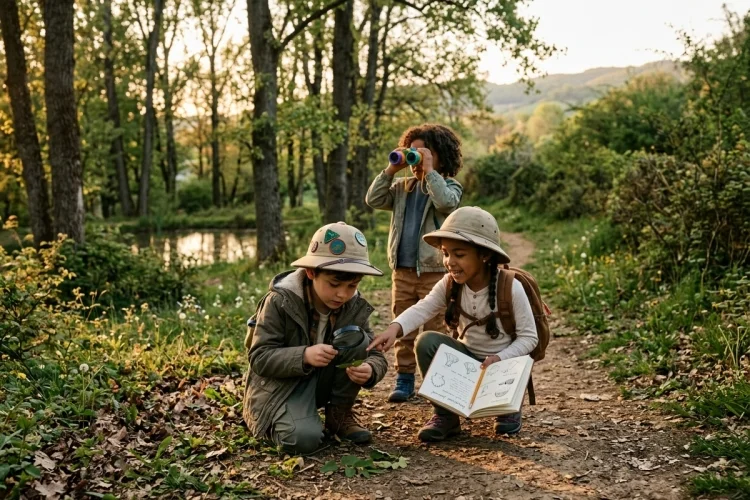
Have you ever wondered what is hiding beneath a fallen leaf, why birds sing in the morning, or where a tiny trail in the park might lead? If questions like these make you excited, you already have one of the most important qualities of an explorer: curiosity.
You do not need to sail across an ocean or climb the tallest mountain to have an adventure. A garden, beach, city street, local park, or even your own backyard can be filled with interesting discoveries.
The secret is learning how to slow down, look carefully, and notice things that other people might walk past. Learning how to become a great little explorer is about more than travelling to new places.
It means asking questions, observing your surroundings, staying safe, respecting nature, and recording what you discover. It also means being brave enough to try something new while knowing when to ask an adult for help.
Grab your imaginary explorer hat. It is time to begin your next adventure!
Start Every Adventure with Curiosity
Every great exploration begins with a question. You might ask why ants walk in a line, how smooth stones are formed, or what makes one tree different from another.
Do not worry if your question sounds strange. Unusual questions often lead to the most exciting discoveries. Instead of immediately searching for an answer, try making a prediction first.
For example, imagine that you see more snails in the garden after it rains. You could ask, “Why do snails come out when the ground is wet?” Then observe where they travel, how quickly they move, and which places they seem to prefer.
Play and exploration help children make sense of the world while developing useful skills such as creativity and problem-solving. UNICEF notes that when children play, they explore their surroundings and build abilities that can support learning throughout life.
A curious explorer does not simply say, “I don’t know.” A curious explorer says, “I don’t know yet, so let’s investigate.”
Train Your Explorer Eyes and Ears
Explorers are excellent observers. They use their senses to collect clues about the places they visit.
Begin by standing still for one minute. Look for different colours, shapes, shadows, and movements. You may notice a spiderweb between two branches, a cloud shaped like an animal, or several kinds of leaves growing in one small area.
Next, close your eyes and listen. Can you hear birds, insects, flowing water, wind, footsteps, or distant traffic? Some sounds are easy to notice, while others appear only after you become quiet.
You can also safely notice textures and smells. A tree trunk may feel rough, while a fresh leaf feels smooth. Wet soil may smell completely different from dry ground.
Try playing an observation game called “Five New Things.” During each walk, find five things you have never noticed before.
They do not have to be rare or spectacular. A strange seed, an unusual footprint, or a tiny hole in a wall can become the beginning of a mystery.
Build a Simple Little Explorer Kit
You do not need expensive equipment to explore. A small backpack with a few useful items is enough for most child-friendly adventures.
Your explorer kit might include a notebook, pencil, reusable water bottle, magnifying glass, hat, sunscreen, simple map, and small first-aid kit. Binoculars can also be fun, but they are not essential.
The notebook may become your most valuable tool. Use it to draw plants, record animal sightings, write questions, and describe the weather. You can also note the date and location of each discovery.
For longer outdoor trips, preparation becomes especially important. The National Park Service recommends carrying essential supplies such as navigation tools, sun protection, water, extra clothing, illumination, and first-aid materials when exploring parks or trails.
Always pack with an adult and choose equipment that suits the place you are visiting. A short walk around a neighbourhood requires less gear than a full-day hike.
Learn How to Explore Safely
A great little explorer is adventurous, but never careless. Safety should be part of every mission.
Always tell a responsible adult where you are going. Younger children should explore with a parent, teacher, caregiver, or another trusted adult. Do not wander away from your group, even when something interesting catches your attention.
Before leaving, check the weather and learn about the area. Wear suitable shoes and clothing, carry enough water, and choose a route that matches everyone’s ability.
The National Park Service explains that planning ahead is one of the best ways to make a hiking adventure safe and enjoyable.
Stay on marked paths unless an adult or park guide says it is safe to leave them. Never taste unknown berries, mushrooms, leaves, or water. Avoid touching wild animals, nests, insects, and unfamiliar plants.
Water requires extra care. Children should always ask permission before going near rivers, lakes, pools, or the sea, and they need close adult supervision around water.
Being careful does not make an adventure boring. It allows you to explore confidently and return home with good memories.
Respect Wildlife and Leave Nature as You Found It
Explorers are visitors in the homes of plants and animals. That means every adventurer has a responsibility to protect the places they explore.
Watch wildlife from a safe distance. Do not chase birds, pick up baby animals, shake nests, or feed wild creatures. Human food may be unhealthy for them and can change their natural behaviour.
It may be tempting to collect flowers, rocks, feathers, shells, or interesting pieces of wood. However, these objects often have an important job in the environment. A fallen branch may become shelter for insects, while an empty shell may become a home for another animal.
The Leave No Trace principles encourage visitors to plan ahead, dispose of waste properly, leave natural objects where they are, respect wildlife, and consider other people.
Instead of taking an object home, draw it or photograph it. That way, you keep the memory without removing anything from nature.
A great explorer leaves only footprints, takes only pictures, and carries all rubbish home.
Record Your Discoveries Like a Scientist
Exploration becomes even more exciting when you keep a record of what you find. Scientists use notes, drawings, measurements, photographs, and maps to organise their observations.
Create an explorer journal with one page for each adventure. Write where you went, what the weather was like, what you saw, and which questions appeared in your mind.
You could draw the shape of a leaf, count how many birds visit a tree, or compare two kinds of soil. Do not worry about making perfect artwork. The purpose is to record useful details.
Try returning to the same place at different times. A park may look quiet in the afternoon but become filled with birds early in the morning. A tree may have flowers in one season and fruit in another.
You can also create a simple map. Mark the location of a pond, large tree, bridge, bench, or interesting rock. Add symbols and a key so another person can understand it.
Your journal will slowly become a collection of adventures and show how your observation skills improve.
Turn Ordinary Places into Exciting Missions
You do not have to visit a famous national park to become an explorer. Adventures can happen almost anywhere.
In a backyard, you could complete a mini-beast mission and search for ants, worms, butterflies, beetles, and spiders. In a city, you could study building shapes, signs, public art, old doors, or the different sounds made by vehicles.
At the beach, look for patterns in the sand and observe how waves change the shoreline. Inside your home, examine everyday objects with a magnifying glass or investigate which materials are attracted to a magnet.
Walking, climbing, searching, and playing outdoors can also support an active lifestyle.
Health guidance recommends that children and teenagers aged 6 to 17 get at least 60 minutes of moderate-to-vigorous physical activity each day. An explorer walk can contribute to that goal while making movement feel like a game.
You can make each trip more exciting by creating a mission. Search for three kinds of leaves, photograph five different colours, identify animal tracks, or find an object shaped like each letter of your name.
Share What You Learn with Other People
A discovery becomes even more meaningful when you share it. Tell your family about an animal you observed, show your classmates a map, or teach a friend how to identify a common tree.
Explaining what you learned also helps you understand it more clearly. Someone may ask a question you had not considered, leading to a new investigation.
The National Park Service Junior Ranger programmes encourage children to explore natural and historical places, learn about them, help protect them, and share their experiences with others.
You could create a small poster, photo album, nature table, or five-minute presentation about your adventure. Another fun idea is starting an explorer club with friends or family members.
Each person can have a role. One explorer may carry the map, another may take notes, and another may photograph discoveries. Working together teaches cooperation and helps everyone notice different details.
Becoming a great little explorer does not require a passport, expensive tools, or a journey into the wilderness. It starts with curiosity, careful observation, sensible preparation, and respect for the world around you.
Ask questions, use all your senses, record what you discover, and explore with a trusted adult. Remember to stay on safe routes, carry the right supplies, protect wildlife, and leave every place as clean as you found it.
Most importantly, keep exploring even when the destination seems ordinary. Your garden, neighbourhood, schoolyard, or local park may contain hundreds of stories waiting to be discovered.
Choose one nearby place, prepare your explorer notebook, and begin a simple mission today. What will you notice that everyone else has missed?