Imagine seeing the number 5 written on a piece of paper. By itself, it simply means five.
Now put a zero after it and you get 50. Add another zero and it becomes 500. Add one more, and suddenly that same digit represents 5,000.
The digit did not change, but its value changed dramatically.
That is the main idea behind place value: ones, tens, hundreds, and thousands. Where a digit appears inside a number tells us how much that digit is worth.
This idea may seem basic, but it supports almost everything children later do with numbers. Addition, subtraction, multiplication, division, rounding, decimals, and even large-number calculations all depend on understanding how our number system is organized.
Fortunately, learning place value does not have to involve endless worksheets. Blocks, coins, drawings, number charts, and everyday examples can make the concept surprisingly easy to understand.
Let’s explore how the system works, one position at a time.
What Is Place Value?
Place value means that the value of a digit depends on its position inside a number.
Consider the number:
444
All three digits are 4, but they do not have the same value.
The first 4 represents 400.
The second represents 40.
The final 4 represents 4.
This happens because our everyday number system uses base ten. Each position is worth ten times as much as the position immediately to its right.
So moving a digit one place to the left makes its value ten times greater.
That simple pattern creates ones, tens, hundreds, thousands, and eventually millions, billions, and beyond.
Understanding the Ones Place
The ones place is the first position on the right side of a whole number.
It tells us how many individual units we have.
For example, in the number 27, the digit 7 is in the ones place. It represents seven individual units.
Imagine 27 apples.
You could organize them as two groups of ten apples plus seven apples left on their own.
Those seven individual apples represent the ones.
Another Simple Example
Look at 143.
The final digit, 3, is in the ones position.
Its value is simply:
3 × 1 = 3
This position is sometimes called the units place, but the idea is the same.
Understanding ones is important because it becomes the starting point for building larger groups.
The Tens Place: Making Groups of Ten
Once we collect ten ones, we can regroup them as one ten.
Think about ten pencils.
Instead of counting each pencil individually every time, imagine tying those ten pencils together with a rubber band. Now you have one bundle of ten.
The tens place is the second position from the right.
In 27, the digit 2 means two groups of ten.
So:
2 tens = 20
and
7 ones = 7
Together:
20 + 7 = 27
This is why the position of a digit matters so much.
A 2 in the ones place means 2. A 2 in the tens place means 20.
Same digit, completely different value.
The Hundreds Place: Ten Tens Make One Hundred
What happens when you collect ten groups of ten?
You get 100.
That creates the hundreds place.
The hundreds position is the third place from the right.
Consider the number 364.
The 3 represents three hundreds, or 300.
The 6 represents six tens, or 60.
The 4 represents four ones.
Put them together:
300 + 60 + 4 = 364
This way of writing a number is known as expanded form.
Expanded form is especially useful because it shows what every digit is actually worth instead of hiding all the values inside one number.
It also helps children understand that 364 is not just three digits sitting next to each other. It is a combination of hundreds, tens, and ones.
The Thousands Place: Building Bigger Numbers
Ten hundreds make one thousand.
The thousands place is the fourth position from the right.
Now consider:
4,582
The digit 4 is in the thousands position, so its value is 4,000.
The 5 means 500.
The 8 represents 80.
The 2 means 2.
In expanded form:
4,000 + 500 + 80 + 2 = 4,582
Notice how quickly values increase as we move left.
A 4 could represent four, forty, four hundred, or four thousand depending entirely on where it appears.
This repeating power-of-ten structure is what makes our decimal number system so effecient.
Why Zero Is So Important in Place Value
Zero may look like it represents “nothing,” but it performs an extremely important job.
It can act as a placeholder.
Compare:
52
and
502
These numbers are very different.
In 52, we have five tens and two ones.
In 502, we have five hundreds, zero tens, and two ones.
The zero tells us that the tens position is empty. Without it, we would read 502 as 52.
Consider another example:
3,006
This means:
3 thousands
0 hundreds
0 tens
6 ones
Those zeros keep every digit in the correct position.
So while zero may represent no quantity in a particular place, it helps preserve the structure of the entire number.
Reading Numbers With a Place Value Chart
A place value chart can make larger numbers easier to understand.
Imagine four columns:
Thousands | Hundreds | Tens | Ones
Now place the number 2,731 into those columns.
The 2 belongs under thousands, the 7 under hundreds, the 3 under tens, and the 1 under ones.
That gives us:
2,000 + 700 + 30 + 1
The chart makes each digit’s value visible immediately.
This strategy is particularly helpful when children begin comparing numbers.
Suppose you compare:
3,812
and
3,721
Both begin with 3 thousands, so the thousands digits are equal.
Next, compare the hundreds positions. Eight hundreds is greater than seven hundreds, so 3,812 is the larger number.
You do not need to examine the remaining digits.
Standard Form, Word Form, and Expanded Form
Numbers can be represented in several different ways.
The most common is standard form, which is how we usually write numbers:
6,245
In word form, we write:
six thousand two hundred forty-five
In expanded form, we show the value of each digit:
6,000 + 200 + 40 + 5
Being able to move between these representations helps children develop stronger number sense.
For example, if a teacher says “seven thousand, three hundred, and eight,” a student who understands digit positions can recognize that the number is:
7,308
The zero is necessary because there are no tens.
Without a solid understanding of positional value, numbers like this can become confusing very quikly.
How Place Value Helps With Addition and Subtraction
The concept becomes especially useful when children begin solving arithmetic problems.
Consider:
243 + 135
Instead of treating each number as one mysterious object, break them into values.
243 contains 200, 40, and 3.
135 contains 100, 30, and 5.
Now combine matching positions:
Hundreds combine with hundreds, tens with tens, and ones with ones.
The result is:
378
The same principle explains why written addition and subtraction problems line numbers up vertically.
Ones need to be beneath ones. Tens need to be beneath tens.
If the positions are misaligned, the calculation changes completely.
This is why good number-position understanding makes later arithmetic much easier.
Fun Ways to Practice Place Value
Children often learn faster when numbers become physical.
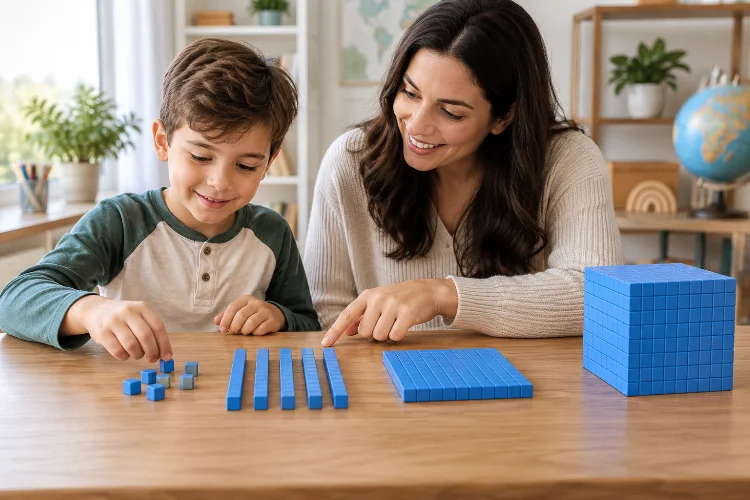
Base-ten blocks are especially useful. Individual cubes can represent ones, rods can represent tens, flat squares can represent hundreds, and larger cubes can represent thousands.
You can also use everyday items.
Ten small coins can become one group of ten. Ten groups of ten can represent one hundred.
Another simple game is to say a number such as 4,321 and ask, “What is the value of the 3?”
The answer is not simply 3.
Because the digit is in the hundreds position, its value is 300.
You can reverse the game too.
Ask, “Which digit has a value of 20 in the number 627?”
The answer is 2.
Small exercises like these help children seperate the idea of a digit from the value that digit represents.
Common Place Value Mistakes
One common mistake is reading the digit instead of its actual value.
For example, when asked for the value of 7 in 372, a child may answer “7.”
The correct answer is 70 because the 7 is in the tens position.
Another mistake appears when zeros are involved.
A learner might write “five thousand twenty-three” as 523 instead of 5,023 because the empty hundreds position feels unnecessary.
Practicing numbers that contain zero is therefore just as important as practicing numbers where every position contains a digit.
A strong understanding comes from asking two questions:
Where is the digit?
and
What is it worth in that position?
Place value is one of the most important foundations in elementary mathematics because it explains how individual digits combine to create larger numbers.
The ones position represents individual units, tens represent groups of ten, hundreds represent groups of one hundred, and thousands represent groups of one thousand.
Every step to the left increases a digit’s value by a factor of ten, while zero helps keep empty positions organised correctly.
Once children understand this structure, expanded form, comparing numbers, addition, subtraction, and larger calculations become much easier.
Try practicing with numbers you see during everyday life. Look at a house number, price, page number, or scoreboard and ask what each digit is worth. Turning ordinary numbers into quick math challenges can make place value feel natural instead of complicated.