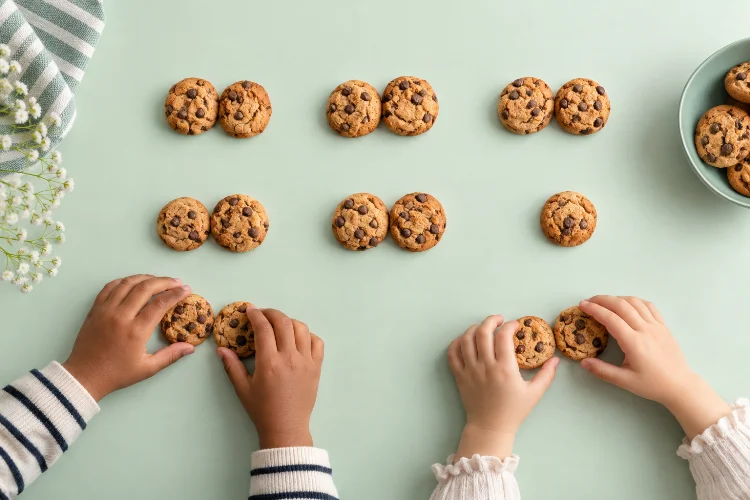
Imagine you have eight cookies and want to share them equally between two friends. Each friend gets four cookies, and nothing is left over.
Now imagine you have seven cookies.
You can give each friend three cookies, but one cookie remains. That tiny leftover cookie shows one of the easiest ways to understand the difference between odd and even numbers.
Learning odd and even numbers explained for kids does not have to feel like memorizing another complicated math rule. In fact, you can understand the idea using socks, toys, candies, pencils, or almost anything that can be arranged into pairs.
Once kids understand how pairs work, identifying odd and even numbers becomes much easier. They can also start noticing useful patterns in addition, subtraction, and multiplication.
In this guide, we will explore what odd and even numbers mean, how to recognize them quickly, why zero counts as even, and some fun ways to pratice the concept at home or in the classroom.
What Are Even Numbers?
An even number is a whole number that can be divided into two equal groups without anything being left over.
Some simple even numbers are:
2, 4, 6, 8, 10, 12, 14, 16
Imagine you have six toy cars.
If you divide them between two children, each child can receive three cars. There are no extra cars left sitting on the table.
That means six is even.
Another way to think about even numbers is through pairs. If every object can find a partner, the total number of objects is even. Math Is Fun uses this pairing idea as a simple way to introduce even and odd numbers.
What Are Odd Numbers?
An odd number cannot be divided evenly into two equal groups of whole objects.
Examples include:
1, 3, 5, 7, 9, 11, 13, 15
Suppose you have five teddy bears and try to arrange them into pairs.
The first two make a pair. The next two make another pair. But one teddy bear has nobody left to stand beside.
That leftover object tells you that five is odd.
This pairing method is especially useful for younger kids because it turns an abstract math idea into something they can actually see and touch.
You do not even need special learning materials. Buttons, crayons, building blocks, coins, or cereal pieces can all work.
The Easy Last-Digit Trick
Pairing objects is great when numbers are small, but what happens when you need to decide whether 4,728 is odd or even?
You probably do not want to collect 4,728 buttons.
Luckily, there is a much easier trick.
1. Even Numbers End in 0, 2, 4, 6, or 8
If a whole number ends in one of these digits, it is even:
0, 2, 4, 6, 8
For example:
24 is even because it ends in 4.
136 is even because it ends in 6.
5,902 is even because it ends in 2.
2. Odd Numbers End in 1, 3, 5, 7, or 9
Odd numbers end in:
1, 3, 5, 7, 9
So 37 is odd because its final digit is 7.
891 is odd because it ends in 1.
Even if a number has hundreds, thousands, or millions of digits, you only need to look at the final digit to determine whether it is odd or even. This standard last-digit rule follows directly from whether an integer can be divided exactly by two.
Why Is Zero an Even Number?
This question surprises a lot of kids.
Is zero really even?
Yes.
Zero is even because it can be divided by two without leaving a remainder.
Think about having zero apples and dividing them between two baskets.
Each basket receives zero apples.
Nothing is left over.
Another way to think about it is through the number pattern:
0, 2, 4, 6, 8, 10
Zero fits perfectly into the pattern of even numbers. It also ends in 0, which is one of the even-number ending digits.
So although zero may feel unusual, mathematically it belongs to the even-number family.
Odd and Even Numbers Alternate
Look at the counting numbers:
1, 2, 3, 4, 5, 6, 7, 8, 9, 10
Notice something?
Odd and even numbers take turns.
Odd, even, odd, even, odd, even.
This pattern continues forever.
If you are standing on an even number and move forward by one, you land on an odd number. Move forward one more time and you return to an even number.
The same happens when counting backward.
Recognizing this pattern can help children build stronger number sense. Instead of viewing each number as completely seperate, they begin seeing relationships between numbers.
This also makes number-line activities useful.
Write numbers from 1 to 20 and circle the even numbers. Then underline the odd ones. The alternating pattern becomes very easy to spot.
What Happens When You Add Odd and Even Numbers?
Odd and even numbers create some fun patterns when you add them together.
For example:
2 + 4 = 6
Even plus even gives an even number.
Now try:
3 + 5 = 8
Odd plus odd also gives an even number.
Why?
Imagine three objects as one pair plus one leftover object. Five objects make two pairs plus one leftover.
When you combine the two leftovers, they form another complete pair. Now everything has a partner.
That is why odd plus odd becomes even.
But what about:
4 + 3 = 7
Even plus odd gives an odd number.
The even group already contains complete pairs. The odd group brings one leftover object, so the final total still has one object without a partner. These addition patterns are consistent for all integers.
Kids do not necessarily need to memorize every rule immediately. Using physical objects can help them discover the patterns themselves.
What Happens When You Multiply Them?
Multiplication creates another interesting set of patterns.
Consider:
4 × 3 = 12
An even number multiplied by an odd number produces an even result.
Try:
6 × 5 = 30
Again, the answer is even.
In fact, whenever one factor is even, the product will also be even.
But when two odd numbers are multiplied, the answer stays odd.
For exmaple:
3 × 5 = 15
and
7 × 3 = 21
Both answers are odd.
These patterns become especially useful later when students work with larger numbers, factors, multiples, algebra, and number properties.
Fun Ways Kids Can Practice Odd and Even Numbers
Math becomes easier when children can connect numbers with real objects.
One simple game is called Find a Pair.
Give a child a random number of small objects. Ask them to arrange everything into groups of two.
If every object has a partner, the number is even. If one object remains, the number is odd.
You can also turn everyday activities into quick math games.
Count the shoes near the door and decide whether the number is odd or even. Count spoons at dinner, books on a shelf, toy cars on the floor, or stairs in the house.
Another activity is an odd-even treasure hunt.
Ask kids to find three things that appear in even quantities and three things that appear in odd quantities.
For older children, call out larger numbers such as 142, 509, 7,836, or 10,001. They can identify the answer using only the final digit.
These short games help number patterns feel familar instead of something that only appears on worksheets.
Why Learning Odd and Even Numbers Matters
Odd and even numbers may seem like a small topic, but they introduce children to a much bigger mathematical idea called parity.
Parity simply describes whether an integer is odd or even.
Understanding parity helps children recognize number patterns, work with multiplication and division, identify factors and multiples, and eventually understand more advanced mathematical relationships.
It also encourages mathematical reasoning.
Instead of simply calculating an answer, children can sometimes predict something about the answer beforehand.
For example, if a child sees:
18 + 24
they can know the answer must be even before calculating the exact total.
That ability to notice patterns is an important part of becoming confident with math.
Odd and even numbers become much easier once kids stop thinking of them as rules to memorize and start thinking about pairs.
If every object can be paired with another object, the number is even. If one object is left without a partner, the number is odd. Kids can also use the final digit to identify larger numbers quickly: 0, 2, 4, 6, and 8 mean even, while 1, 3, 5, 7, and 9 mean odd.
These number patterns also appear in addition and multiplication, making the concept useful far beyond one early math lesson.
Try turning the idea into a game today. Grab some toys, coins, snacks, or pencils, arrange them into pairs, and see how many odd and even numbers you can discover togther.