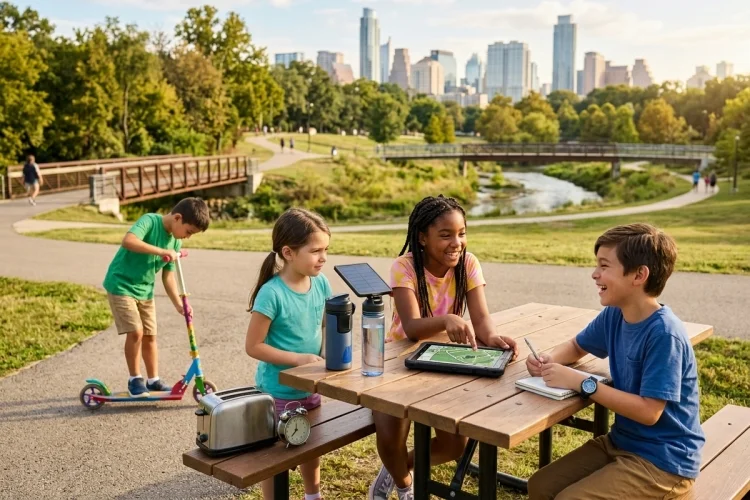
Think about everything you used before breakfast today. Perhaps an alarm woke you up, a light helped you see, a tap delivered clean water, and a toaster warmed your bread.
You may also have checked the time on a phone or travelled to school in a vehicle. All these things are examples of technology.
So, what is technology and how does it help us? Technology includes the tools, systems, processes, and inventions people create to solve problems or meet human needs.
It is not limited to computers, robots, and smartphones. A pencil, wheel, bridge, pair of scissors, and water filter can also be considered technology because each was designed for a purpose.
Technology can make tasks faster, safer, easier, or more accurate. However, it must be designed and used thoughtfully. A useful invention should solve a real problem without creating unnecessary harm.
Let us explore how technology shapes everyday life and how young people can learn to use it wisely.
Technology Is More Than Electronic Devices
Many people hear the word technology and immediately imagine a glowing screen. Digital devices are important examples, but the idea is much broader.
Technology can be any human-made object or process designed to solve a problem. A spoon helps us carry food, an umbrella keeps rain away, and a bicycle allows us to travel farther with less effort.
Even simple inventions can have a huge effect. The wheel made it easier to move heavy objects, while written language allowed people to record and share information across generations.
Technology is closely connected to engineering. Engineers identify needs, create possible solutions, build models, test their ideas, and improve the design. A product may go through many versions before it works reliably.
This means technology is not only the finished object. It also includes the knowledge, planning, and systems that make the object useful.
Technology Helps Us Communicate
Communication technology allows people to exchange ideas across short and long distances. Letters, printing presses, radios, telephones, television, email, and video calls are all part of this story.
Today, someone can send a message across the world in seconds. Families living in different countries can speak face to face through a screen, while students can collaborate with classmates without sitting in the same room.
The internet also provides access to news, maps, libraries, educational videos, and public services.
According to the International Telecommunication Union, around six billion people-or 74 percent of the global population-were online in 2025. However, approximately 2.2 billion people still remained offline, showing that access is not equal everywhere.
Fast communication is useful, but it creates responsibilities. Messages can be misunderstood, private information can spread, and incorrect claims can travel quickly. Good digital communication requires kindness, careful thinking, and respect for privacy.
Technology Supports Learning and Discovery
Technology gives students new ways to explore subjects. A child can watch an animation of the solar system, take a virtual museum tour, practise a language, or enlarge an image of a tiny cell.
Digital tools can also make learning more flexible. Recorded lessons can be replayed, text can be translated, and interactive exercises can provide immediate feedback.
However, a device does not automatically improve education. UNESCO explains that educational technology should support clear learning goals and strengthen teaching rather than replace the important relationship between teachers and students.
Access, affordability, teacher preparation, and evidence of effectiveness also matter.
Technology works best as one tool among many. Children still need conversations, books, physical activity, creative play, practical experiments, and guidance from knowledgeable adults.
For example, a tablet can show how a plant grows, but planting a real seed allows a learner to touch the soil, measure the stem, and observe changes over time. The two experiences can support each other.
Technology Improves Health and Independence
Healthcare depends on many kinds of technology. Thermometers measure temperature, microscopes reveal tiny organisms, scanners create images from inside the body, and laboratory equipment helps doctors investigate illness.
Technology can also support people with disabilities or health conditions. This is known as assistive technology.
Examples include glasses, hearing aids, wheelchairs, prosthetic limbs, communication devices, screen readers, speech-recognition software, and captions.
The World Health Organization says these products can support movement, communication, vision, hearing, learning, employment, and independent daily activities.
Consider a child who cannot easily read small printed text. A digital magnifier or text-to-speech program may make the same information more accessible. Someone who cannot speak may use a communication device to express needs and join conversations.
Good technology does more than perform impressive tasks. It can remove barriers and help more people participate fully in school, work, family life, and the community.
Technology Makes Work and Everyday Tasks Easier
Many household tools were invented to save effort or time. Washing machines clean clothes, refrigerators keep food cool, and vacuum cleaners help remove dust.
In workplaces, machines can lift heavy materials, repeat precise movements, calculate large amounts of information, and perform tasks in dangerous environments.
Farmers use irrigation systems, weather data, and machinery to manage crops. Builders use measuring tools, safety equipment, and computer-assisted designs.
Technology can improve efficiency, but it also changes the skills people need. When machines take over repetitive tasks, workers may need to learn how to operate, repair, monitor, or design new systems.
This is why digital literacy and problem-solving are becoming increasingly important. People need to understand not only how to press buttons but also how a tool works, when it is useful, and whether its results can be trusted.
Technology should assist human judgment rather than remove the need to think.
Technology Helps Us Travel and Find Places
Transport technology helps people and goods move from one location to another. Bicycles, trains, cars, ships, and aircraft make journeys possible at different speeds and distances.
Modern navigation systems use satellites, digital maps, sensors, and stored location information. They can suggest a route, estimate travel time, and warn drivers about traffic.
Public transport systems also rely on technology. Electronic tickets, arrival displays, traffic signals, and scheduling software help organise large numbers of journeys.
These inventions can save time, but they are not perfect. A map application may contain outdated information, lose its signal, or recommend an unsuitable route. Travellers still need to observe road signs, follow safety rules, and understand their surroundings.
A helpful tool gives guidance, but the user remains responsible for making sensible decisions.
Technology Can Help Protect People and the Planet
Some technologies are designed to monitor dangers and reduce waste. Weather instruments help track storms, smoke detectors warn people about fire, and water-treatment systems make water safer to use.
Scientists use sensors, satellites, cameras, and computer models to study forests, oceans, air quality, wildlife, and changing weather patterns. This information can help communities prepare for hazards and make better environmental decisions.
Renewable-energy technologies, such as solar panels and wind turbines, produce energy from sources that can be naturally renewed. Other inventions help buildings use less electricity or allow materials to be recycled.
Still, technology can create environmental problems too. Manufacturing devices requires energy and raw materials, while broken electronics can become waste.
The important question is not simply, “Is this technology new?” We should ask whether it is durable, repairable, efficient, accessible, and genuinely helpful. Innovation is most valuable when it considers both people and the environment.
Technology Must Be Used Safely and Responsibly
Every tool can be helpful or harmful depending on how it is used. A kitchen knife prepares food but can cause injury. The internet provides knowledge but can also expose users to scams, bullying, misinformation, and privacy risks.
Children should protect personal details such as passwords, addresses, school information, and private photographs. Suspicious messages, uncomfortable conversations, and requests for secrecy should be shown to a trusted adult.
UNICEF notes that digital technology creates major opportunities for learning and connection, but children also need protection from risks involving privacy, harmful content, exploitation, and unsafe interactions.
Healthy technology use also includes knowing when to stop. Screens should not replace sleep, outdoor movement, face-to-face friendships, meals, or family conversations.
Responsible users think before they click, check information before sharing it, treat others respectfully, and ask for help when something feels wrong.
Children Can Become Technology Creators
Children do not have to remain passive users of technology. They can become designers, builders, programmers, inventors, and problem-solvers.
The process can start with a simple question: “What problem do I want to solve?” A child might design a cardboard stand that keeps a book open, create a reminder system for watering plants, or build a container that protects an egg from a fall.
The first design does not need to be perfect. Engineering usually involves testing, noticing weaknesses, changing the idea, and testing again.
Young creators can also ask important questions about the people who will use their invention. Is it easy to understand? Is it safe? Can someone with limited vision or movement use it? Does it waste materials?
Technology becomes more meaningful when it begins with empathy. The best inventions are not always the most complicated ones. They are the ones that solve real problems in thoughtful and practical ways.
What is technology and how does it help us? Technology includes the objects, processes, and systems people design to meet needs and solve problems.
It supports communication, education, healthcare, transportation, work, accessibility, safety, and scientific discovery. Yet technology is not automatically good simply because it is modern.
Its value depends on how it is designed, who can access it, and how responsibly people use it. Look around your home or classroom and choose one human-made object.
Ask what problem it solves, how it could be improved, and whether everyone can use it easily. By observing technology carefully instead of simply consuming it, you take the first step toward becoming a thoughtful inventor.