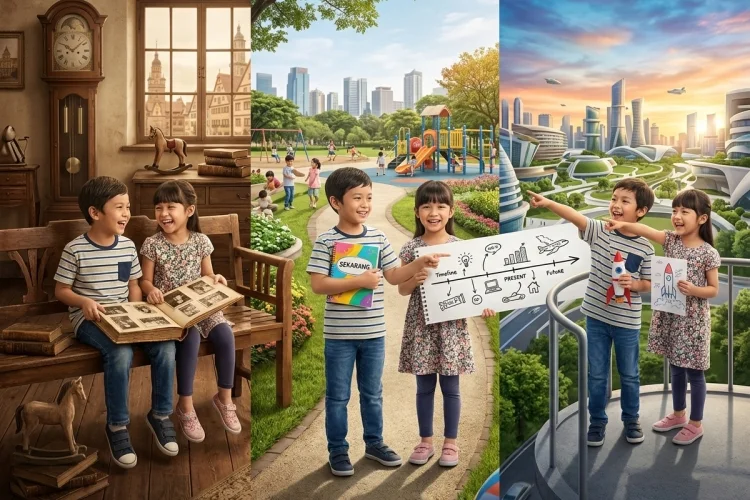
Imagine having a time machine with three buttons. One button takes you to something that has already happened, another keeps you exactly where you are, and the last sends you toward something that has not happened yet.
Those three destinations are called the past, present, and future. We use them every day when we tell stories, make plans, remember special moments, or explain what we are doing right now.
Understanding time may sound easy to adults, but it develops gradually during childhood. Words such as “yesterday,” “later,” and “next month” describe ideas that cannot always be seen or touched.
Conversations about routines, family memories, and upcoming events help children connect these words to real experiences.
In this guide, we will explore the past, present, and future through simple examples, timelines, grammar, and playful activities. Get ready for a quick journey through time-no magical machine required!
What Are the Past, Present, and Future?
The past, present, and future are three ways of describing when something happens.
The past includes events that have already taken place. The present is what is happening now. The future includes events that have not happened yet.
Here is a simple example:
Yesterday, Mia planted a seed. Today, she is watering it. Tomorrow, she will check whether it has started to grow.
These three sentences describe one activity at different points in time. Planting happened in the past, watering is happening in the present, and checking the seed belongs to the future.
We can imagine time as a road. The part behind us is the past, our current position is the present, and the road ahead represents the future.
The Past Is Everything That Already Happened
The past can mean five minutes ago, yesterday, last year, or thousands of years ago. Once an event has happened, it becomes part of the past.
Your breakfast this morning is now in the past. So is your first day of school, even if you remember it clearly. Dinosaurs, ancient cities, and the childhoods of your grandparents also belong to earlier times.
Memories help us think about our personal past. Photographs, letters, toys, buildings, recordings, and family stories can also show us what life was like before today.
Historians use these kinds of clues to study earlier people and events. The Library of Congress recommends using personal stories, interviews, and primary sources to help children organise information and create timelines connecting different generations.
However, not every memory is complete. Two people may remember the same event differently, which is why historians often compare several sources.
The Present Is Happening Right Now
The present is the moment you are experiencing now. You might be reading, sitting, breathing, or listening to sounds around you.
Some present events last only a few seconds. A bird may fly past your window, or a phone may ring. Other situations continue for longer periods. You can say, “I am learning English this year,” even though you are not studying every second of the year.
The present connects the past with the future. What happened before can affect your current situation, while what you do today may influence what happens later.
For example, practising the piano in the present can improve your future performance. Forgetting to water a plant today may affect how healthy it looks next week.
Paying attention to the present also helps us notice what is happening instead of constantly thinking about yesterday or worrying about tomorrow.
The Future Has Not Happened Yet
The future begins after the present moment. It can mean the next minute, tomorrow, next year, or a time far beyond our own lives.
Some future events are planned. A class trip may be scheduled for Friday, or your family may plan to visit someone next month.
Other future events are predictions. You might think it will rain tomorrow because the sky is dark, but your prediction could be wrong. The future contains possibilities, which means it is not always completely certain.
Young children often understand events in the immediate future more easily than events far away. Research on children’s time language suggests that nearby, more certain events can be easier to understand than events planned for a more distant time.
This is why saying “We will eat after this game” may be clearer than saying “We will visit them in three months.”
Time Words Tell Us When Something Happens
Certain words give clues about whether an event belongs to the past, present, or future.
Past-time words include yesterday, ago, earlier, last week, and when I was younger. Present-time words include now, today, currently, and at the moment.
Future-time expressions include tomorrow, later, soon, next year, and one day.
Consider these sentences:
“Leo played football yesterday.”
“Leo is playing football now.”
“Leo will play football tomorrow.”
The time words make the order clear. Without them, listeners may need more information to understand when the activity happened.
Adults can strengthen children’s understanding by using time language during normal routines. Phrases such as “this morning,” “after lunch,” “yesterday,” and “tomorrow” connect abstract ideas with events children recognise.
Verb Tenses Show Different Times
Verbs are action or state words, and their forms often change according to time. These changes are called tenses.
1. Past Tense
The past tense describes something that already happened.
“I walked to school.”
“She painted a picture.”
“They were tired.”
Many English verbs add -ed in the past, but some are irregular. “Go” becomes “went,” while “eat” becomes “ate.”
2. Present Tense
The present tense can describe what happens now, what regularly happens, or what is generally true.
“I am walking to school.”
“She paints every weekend.”
“The Sun gives us light.”
3. Future Time
English often uses will or going to when discussing future events.
“I will walk to school tomorrow.”
“She is going to paint a picture.”
English grammar can become more complicated because present forms are sometimes used in clauses about future time, such as “I will call you when I arrive.”
For beginners, the most important goal is noticing that language gives clues about when an action occurs.
Timelines Put Events in the Correct Order
A timeline is a line that displays events in chronological order. Chronological means arranged from earlier to later.
Suppose you make a timeline about your morning:
7:00 — Wake up
7:15 — Eat breakfast
7:40 — Leave home
8:00 — Arrive at school
The event on the left or at the top usually happened first. Later events follow in sequence.
Timelines can cover one hour, one person’s life, or thousands of years. Museums, historians, teachers, and students use them to show how events connect over time.
The Library of Congress provides timeline-based activities that organise personal stories, family experiences, and historical sources.
A timeline also helps us compare past and present. Children can place an old toy beside a modern toy, for example, and discuss what has changed and what has stayed similar.
Calendars Help Us Plan Future Events
A calendar divides time into days, weeks, months, and years. It helps us remember birthdays, holidays, appointments, lessons, and deadlines.
However, reading a calendar involves more than recognising numbers. Children must understand that time follows a sequence and that future events move closer as days pass.
Early childhood guidance notes that a genuine understanding of dates develops gradually. Young children may recite days of the week before fully understanding how far yesterday or next month is from the present.
Calendars become more meaningful when they include events children care about. Marking a birthday, library visit, or sports day gives each date a clear purpose.
Instead of asking children to memorise an entire calendar, adults can say, “Today is Tuesday. Our trip is on Thursday, so we have two more days.”
Why Understanding Time Is Important
Knowing the difference between past, present, and future supports many everyday skills.
Children use time concepts when following routines, telling stories, remembering instructions, and planning tasks. Saying what happened first, next, and last makes communication much clearer.
Time awareness also supports responsibility. A child can understand that homework completed today will be ready for tomorrow, or that leaving late may affect when the family arrives.
In history, students compare past societies with life today. In science, they observe how something changes over several days. In reading, they follow the order of events in a story.
Understanding time also helps children imagine possibilities. Smithsonian education resources describe making connections between the past, present, and future as a way for young people to think about their communities and the role they can play in shaping them.
Fun Ways to Practise Past, Present, and Future
One easy activity is to divide a sheet of paper into three sections. Label them Past, Present, and Future, then draw one event in each section.
You might draw yourself eating breakfast in the past, reading in the present, and playing outside in the future.
Another activity is creating a personal timeline. Include your birth, your first day of school, something happening now, and one future goal. The future part could show learning to swim, visiting a new place, or starting another school year.
Children can also sort sentences into time groups. “I lost a tooth,” belongs in the past. “I am wearing blue,” describes the present. “I will visit the park,” belongs in the future.
Family photographs are useful too. Compare an old photograph with one taken recently, then discuss what may change in another ten years.
The past, present, and future help us organise experiences and understand when events happen. The past contains what has already occurred, the present is happening now, and the future includes plans, predictions, and possibilities.
Time words, verb tenses, calendars, routines, and timelines make these ideas easier to understand. They also help children tell stories, study history, follow schedules, and think about goals.
Create a three-part time journal today. Write one thing you did yesterday, one thing you are doing now, and one thing you hope to do tomorrow.
With a little practice, you will become an expert time traveller who can move through stories, memories, and plans without ever leaving the room.