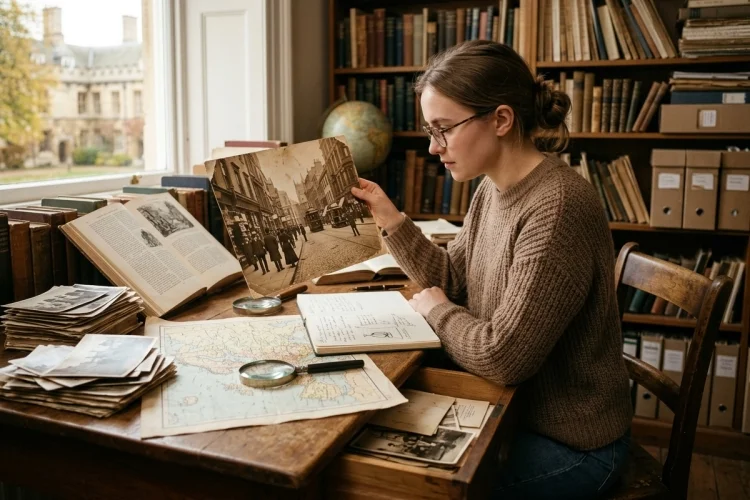
Imagine finding an old photograph in a drawer. The people are wearing unfamiliar clothes, the street looks completely different, and nobody remembers exactly when the picture was taken.
How could you discover the story behind it? You might ask an older relative, study the buildings, examine objects in the background, or compare the photograph with other records.
Without realising it, you would be thinking like a historian. So, what is history and why do we study it? History is the investigation and interpretation of the human past using evidence.
It includes famous rulers, wars, inventions, and political events, but it also explores families, workers, children, food, fashion, beliefs, migration, technology, and everyday life.
Studying history is not simply about memorising names and dates. It teaches us to ask questions, examine sources, compare viewpoints, and explain why change happened.
By exploring earlier societies, we gain a clearer understanding of the world we live in today-and of the choices that may shape tomorrow.
History Is More Than a List of Past Events
The past includes everything that has already happened. History is the process of investigating, organising, and explaining parts of that past.
Historians do not have a complete recording of every human experience. Instead, they develop arguments based on surviving evidence, including written records, objects, oral traditions, photographs, buildings, and works of art.
The American Historical Association explains that writing history involves making claims about the past and supporting them with evidence left by earlier people.
This means a history book is not simply the past copied onto paper. It is an interpretation created by someone who has selected evidence, placed it in context, and decided how different facts are connected.
Good historical work must explain why a conclusion is reasonable. It should also recognise uncertainty when the available evidence is incomplete.
Historians Work Like Detectives
Historians begin with questions. They may ask why an empire collapsed, how ordinary people experienced a war, or what caused attitudes toward education to change.
They then search for clues called historical sources. These sources are commonly divided into primary and secondary materials.
1. Primary Sources
Primary sources were created during the period being studied. They can include diaries, letters, speeches, photographs, maps, newspapers, tools, clothing, official records, and recorded interviews.
The Library of Congress describes primary sources as the raw materials of history because they were created at the time under investigation.
A soldier’s letter, for example, may reveal personal thoughts about a conflict. However, it represents one person’s experience and cannot automatically explain what every soldier believed.
2. Secondary Sources
Secondary sources are later explanations or interpretations. Textbooks, documentaries, biographies, and academic articles often fall into this category.
Historians compare many sources because one document rarely provides the whole story. They ask who created it, why it was produced, what information it contains, and what may be missing.
The National Archives notes that working with original records helps students recognise that historical writing reflects interpretation rather than offering a completely neutral window into the past.
History Helps Explain the Present
Many parts of modern life have long histories. Governments, national borders, languages, laws, traditions, schools, and economic systems did not suddenly appear in their current forms.
For example, understanding why a city contains several cultural communities may require learning about trade, migration, colonisation, conflict, or employment patterns. A current disagreement over land may make little sense without knowing how ownership changed in earlier generations.
History gives context to these situations. It helps us see that the present is the result of many decisions, accidents, struggles, and gradual developments.
The American Historical Association argues that studying history helps people understand why societies and the wider world are the way they are.
Historical knowledge does not provide a simple answer to every modern problem. It does, however, help us avoid discussing current issues as though nothing came before them.
History Shows Change and Continuity
One of the most interesting historical questions is: What changed, and what stayed the same?
Technology may change quickly, while social beliefs can take generations to shift. A country may gain a new government but keep older laws, institutions, or inequalities.
Consider communication. People once depended mainly on handwritten letters for long-distance personal messages. Later generations used telephones, email, and social media.
The tools changed dramatically, but the human desire to share news, maintain relationships, and influence others remained.
Looking at change and continuity helps students avoid overly simple stories. Historical developments rarely happen because of only one person or event.
They often result from a combination of economic conditions, political choices, cultural beliefs, environmental pressures, and human actions.
Historical reasoning therefore involves connecting events across time rather than treating them as isolated facts.
Studying History Builds Critical Thinking
History teaches us not to accept every claim immediately. Instead, we learn to ask what evidence supports it.
Suppose two newspaper articles describe the same protest differently. One calls it peaceful, while the other focuses on disorder.
A history student would examine who wrote each report, when it was published, which details were included, and whether photographs or eyewitness accounts support either version.
These skills are useful far beyond school. Online posts, political speeches, advertisements, and videos may present selective information or remove events from their original context.
Primary-source analysis encourages students to observe carefully, ask questions, reflect on context, and make informed judgments.
History does not teach us to distrust everything. It teaches us to judge information more carefully and recognise the difference between a claim, an opinion, and well-supported evidence.
History Helps Us Understand Different Perspectives
People in the past did not all think in the same way. Their experiences depended on factors such as location, class, age, occupation, gender, culture, religion, and political power.
A factory owner and a factory worker might describe industrialisation very differently. A government report about a conflict may not match the memories of civilians who lived through it.
Studying several perspectives creates a fuller picture. It also helps us understand why people made choices that may seem strange when viewed only through modern expectations.
Understanding a perspective does not mean approving of every belief or action. It means examining the circumstances, ideas, and pressures that influenced someone.
History can therefore support empathy while still allowing moral judgment. UNESCO highlights the role of learning about difficult pasts in preserving memory, encouraging critical thinking, and supporting informed dialogue.
Can History Stop Us from Repeating Mistakes?
People often say that studying history prevents us from repeating the past. The idea is useful, but reality is more complicated.
Historical situations never repeat in exactly the same way. Technology, leadership, culture, and global conditions change. A solution that worked in one century may fail in another.
Still, history offers examples of how people responded to crises, injustice, disease, economic change, and political conflict. We can examine what they attempted, what consequences followed, and which warning signs were ignored.
The American Historical Association describes the past as an important source of evidence for understanding how people and societies behave.
History is not a crystal ball. It is more like a large collection of case studies that can improve the questions we ask before making decisions.
History Shapes Identity and Belonging
History helps people understand where they come from. Family stories, local traditions, national events, and community memories all contribute to identity.
A child might begin by asking why their family celebrates a particular festival or how their neighbourhood received its name. These small questions can lead to wider topics such as religion, migration, language, work, or political change.
However, historical identity should not be based on only one heroic or comfortable story. Every society includes success, struggle, cooperation, disagreement, and injustice.
Exploring a wider range of voices makes history more accurate and inclusive. It allows groups that were overlooked in older accounts to become visible.
The AHA notes that history gives students opportunities to explore different regions, communities, identities, and experiences as part of a fuller understanding of the past.
How to Make Studying History More Interesting
History becomes more engaging when you treat it as an investigation rather than a list to memorise.
Start with a question. Instead of trying to remember everything about an ancient city, ask how ordinary families lived, where their food came from, or why people eventually left.
Use different types of evidence. Compare a photograph, map, personal letter, museum object, and textbook explanation. Notice what each source can reveal and what it cannot.
Timelines are helpful for organising events, but stories make those events feel human. Look for individual experiences that connect large developments with daily life.
You can also explore local history. Visit a museum, study an old building, interview an older relative, or compare historical maps with your neighbourhood today.
The National Archives and Library of Congress provide collections and analysis tools that allow learners to work directly with original documents.
The goal is not only to ask, “What happened?” Ask “Why?”, “Who was affected?”, “What changed?”, and “How do we know?”
What is history and why do we study it? History is an evidence-based investigation of human life in the past. It helps us understand how societies developed, why change occurred, and how different people experienced the same events.
Studying history also strengthens critical thinking. It teaches us to examine sources, recognise bias, compare interpretations, and build conclusions carefully. At the same time, it introduces us to lives and perspectives beyond our own.
Choose one historical mystery today. Ask an older relative about a family photograph, investigate the story of a local building, or examine an original document online.
Do not stop after learning what happened. Look for evidence, question the story, and discover why the past still matters.