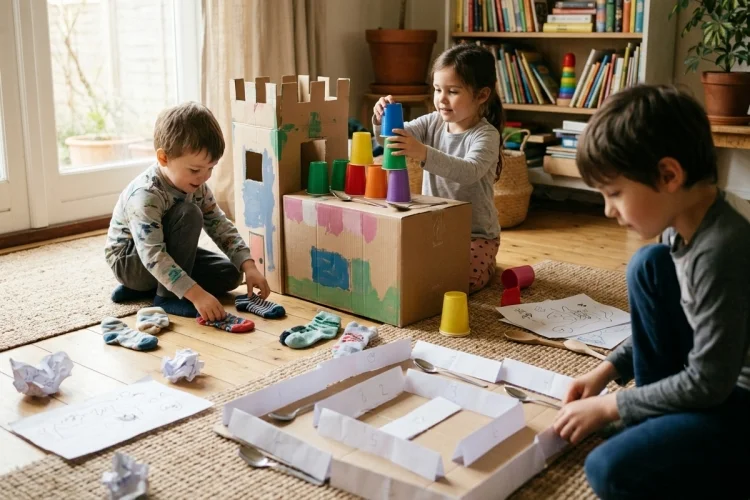
A cardboard box may look like rubbish to an adult, but to a child, it could be a castle, shop, spaceship, or science laboratory. Add a few spoons, socks, cups, and sheets of paper, and you already have enough materials for an afternoon of playful learning.
These educational games using household objects prove that children do not need expensive toys or complicated apps to develop useful skills.
Everyday materials can support counting, reading, problem-solving, creativity, communication, and physical coordination. Play is not simply a break from learning.
It gives children opportunities to practise attention, working memory, self-control, decision-making, and flexible thinking. Harvard’s Center on the Developing Child explains that playful activities can help strengthen these executive-function skills over time.
The activities below are easy to adapt for different ages. Choose clean, safe materials, supervise younger children, and focus on exploration rather than perfect answers. Let the games begin!
Why Household-Object Games Work
Familiar objects make learning feel connected to real life. Sorting laundry introduces categories, cooking tools encourage measurement, and food packages provide letters, numbers, colours, and shapes.
Open-ended materials are especially valuable because they can be used in many ways. A paper cup can become a tower block, musical instrument, target, telephone, or container for counting objects.
UNICEF notes that children do not need expensive toys to play and learn. Simple household items can help them classify objects by colour, shape, and size while encouraging imagination.
These games are also flexible. Adults can simplify the instructions for preschoolers or add reading, calculations, time limits, and strategy challenges for older children.
Make Safety Part of the Game
Inspect every material before play begins. Avoid sharp edges, broken objects, cleaning products, glass containers, hot appliances, medicines, loose batteries, and powerful magnets.
Small items such as buttons, coins, beads, and bottle caps can become choking hazards. The American Academy of Pediatrics advises keeping small household objects away from young children and choosing materials that are too large to fit inside their mouths.
Stay nearby when children use string, water, scissors, or objects that could be thrown. Adjust every game to match the child’s age, abilities, and available space.
Literacy and Language Games
1. Alphabet Treasure Search
Write several letters on small pieces of paper and hide them around one room. Ask children to find the letters and name a word beginning with each one.
Older learners can arrange the collected letters into words or alphabetic order.
2. Food-Package Word Hunt
Collect clean cereal boxes, food labels, and empty cartons. Challenge children to find particular letters, short words, punctuation marks, or numbers.
Beginning readers can search for the first letter of their names, while older children can identify nouns, verbs, or descriptive words.
3. Sock Story Characters
Place clean socks over your hands and turn them into puppets. Give each puppet a name, personality, and problem to solve.
This game encourages storytelling, dialogue, vocabulary, and confidence in speaking.
4. Mystery Object Description
Place a familiar object inside a bag without letting the child see it. The player feels the object and describes its texture, shape, size, and possible purpose.
Encourage precise words such as smooth, curved, heavy, or flexible.
5. Paper-Plate Story Spinner
Divide a paper plate into sections and draw a character, setting, object, or problem in each part. Spin a pencil in the centre and use the selected pictures to invent a story.
Add another plate containing possible endings for a more challenging version.
Maths and Number Games
6. Spoon Sorting Challenge
Gather spoons of different sizes, colours, or materials. Ask children to sort them and explain the rule they used.
They can then arrange the spoons from shortest to longest or count how many belong in each group.
7. Laundry Basket Basketball Maths
Place a laundry basket a safe distance away and throw rolled-up socks into it. Award one, two, or five points depending on the throwing line.
Children must calculate their total after each round.
8. Cup-Tower Counting
Use reusable plastic or paper cups to build a tower. Count how many cups are used in each level and compare different designs.
Older children can calculate the total, estimate the tower’s height, or build one following a numerical pattern.
9. Homemade Number Line
Write consecutive numbers on sheets of paper and place them across the floor. Children can jump forward for addition and backward for subtraction.
For example, begin on four and jump three spaces to discover that four plus three equals seven.
10. Pretend Household Shop
Add paper price tags to toys, books, or safe kitchen items. Give children pretend money and let them practise buying, adding totals, comparing prices, and calculating change.
Simple household materials can become powerful tools for early mathematical learning, including sorting, comparing sizes, and discussing quantities.
Science and Problem-Solving Games
11. Sink-or-Float Predictions
Collect safe objects such as a spoon, cork, plastic lid, sponge, and stone. Ask children to predict whether each one will sink or float before testing it in a bowl of water.
Record the results and discuss why size alone does not determine what happens.
12. Paper Bridge Challenge
Place two books a short distance apart and give children sheets of paper. Their mission is to build a bridge strong enough to hold several coins or toy figures.
Folding, rolling, or layering the paper introduces ideas about structure and engineering.
13. Magnet Detective
With adult supervision, use a child-safe magnet to test household objects. Children can predict whether each item will be attracted before checking.
Discuss the materials in objects that respond to the magnet and those that do not.
14. Ice-Melting Race
Place equal ice cubes on different safe materials, such as a metal tray, plastic plate, cloth, and wooden board. Predict which cube will melt first.
Observe the cubes at regular intervals and compare how materials transfer heat.
15. Mystery Sound Match
Fill identical containers with different safe materials, such as rice, pasta, cotton, or paper. Shake them and ask children to match containers that produce similar sounds.
This activity develops listening, comparison, and prediction skills.
Creativity and Imagination Games
16. Cardboard-Box Transformation
Provide an empty box, paper, tape, and crayons. Ask children to transform it into anything they imagine.
Avoid showing one finished model to copy. An open challenge encourages original planning and experimentation.
17. Kitchen-Band Concert
Use wooden spoons, plastic bowls, empty containers, and sealed rice shakers to make music. Experiment with loud, soft, fast, and slow rhythms.
Children can copy a rhythm or become the conductor and create their own sequence.
18. Recycled Sculpture Challenge
Collect clean cartons, tubes, paper, and boxes. Challenge children to build an animal, robot, vehicle, or imaginary machine.
NAEYC recommends a variety of everyday materials for home makerspaces because they encourage creativity and hands-on learning.
19. Shadow Drawing
Place a toy or household object near a sunny window and trace its shadow on paper. Repeat the activity later and compare the shadow’s position and length.
This combines art with observation of light and change over time.
20. Make-Believe Restaurant
Use paper menus, empty containers, plates, and safe utensils to create a pretend restaurant. Children can become customers, cooks, cashiers, or servers.
The game develops language, social cooperation, writing, counting, and imaginative thinking.
Movement, Memory, and Social Games
21. Indoor Obstacle Course
Use cushions, tape lines, chairs, and boxes to create a safe route. Children might step over a cushion, crawl beneath a table, and balance along a taped line.
UNICEF suggests using objects found around the home to create screen-free obstacle courses suited to a child’s age and abilities.
22. Tray Memory Game
Place six household objects on a tray and allow children to study them for 30 seconds. Cover the tray, remove one object, and ask what is missing.
Increase the number of objects as their working memory improves.
23. Follow-the-Spoon Rhythm
Tap a spoon gently against a bowl to create a short rhythm. The child listens and copies it exactly.
Add longer patterns or let players take turns leading the game.
24. Cushion Island Challenge
Spread cushions across the floor and pretend that the surrounding area is water. Children must travel from one side of the room to the other without touching the floor.
Encourage them to plan their route, cooperate, and move the cushions safely rather than jumping too far.
25. Household Scavenger Race
Give children clues such as “Find something soft,” “Find a rectangle,” or “Find an object used for measuring.” Players bring back or point to an appropriate item.
For cooperative play, ask everyone to complete one shared list instead of competing against one another.
Adapt the Games for Different Ages
Preschoolers usually benefit from short instructions, large objects, repetition, and plenty of movement. Focus on colours, simple quantities, matching, vocabulary, and imaginative play.
Primary-school children can handle written clues, scores, measurements, spelling tasks, and multi-step challenges. Older children can design the rules, record data, calculate averages, or create games for younger siblings.
Adaptations can also improve accessibility. Use larger print, audio instructions, textured materials, fewer objects, extra time, or activities that can be completed from a seated position.
The aim is not to make every game difficult. A successful educational activity keeps children engaged while offering a manageable challenge.
Let Children Lead the Play
Adults can introduce a game, but children should have room to change it. A cup-stacking challenge may become a pretend city, while a sorting activity may inspire an imaginary shop.
Follow their questions and ideas when it is safe to do so. NAEYC emphasises that play supports cognitive, language, physical, social, and emotional development, especially when children have meaningful opportunities to explore.
Ask open questions such as, “What else could we try?” or “How could you make it stronger?” These prompts encourage thinking without taking control of the activity.
Educational games using household objects make learning affordable, flexible, and connected to everyday life.
Cups can introduce counting, socks can become story characters, cardboard can inspire engineering, and kitchen tools can create music. The best activities do not require perfect materials or complicated instructions.
They need a safe space, a manageable challenge, and an adult who is interested in the child’s ideas. Choose three household objects today and invent one simple game around them.
Begin with a learning goal such as counting, spelling, observation, or movement, then let the child help create the rules. You may discover that the most useful educational toys were already sitting inside your cupboards.