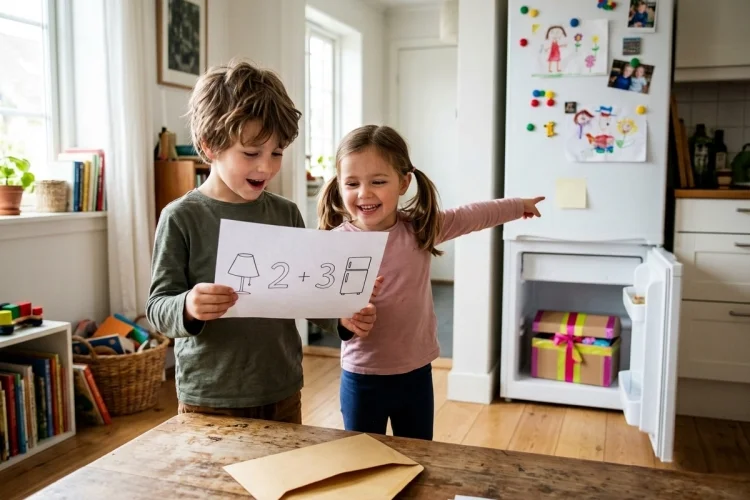
Imagine finding a mysterious envelope under your pillow. Inside, there is a clue that says, “Look where cold food likes to stay.” You race to the refrigerator and discover a maths puzzle that leads to the next hiding place.
That is the magic of a home learning treasure hunt. It turns familiar rooms into an adventure while giving children opportunities to read, count, observe, solve problems, and move their bodies.
Learning through play can support curiosity, concentration, persistence, communication, and problem-solving. NAEYC explains that playful experiences allow children to practise skills across several areas without separating learning from fun.
The best part is that you do not need expensive equipment. Paper, pencils, household objects, and a small reward are usually enough.
In this guide, you will learn how to create a home learning treasure hunt that suits your child’s age, interests, abilities, and current learning goals.
Decide What Children Should Learn
Before writing clues, choose one or two simple learning goals. A treasure hunt becomes confusing when every clue tries to teach a completely different lesson.
For a preschooler, the goal might be recognising colours, shapes, numbers, or beginning sounds. An older child could practise multiplication, spelling, geography, science vocabulary, or reading comprehension.
Suppose your child is learning addition. Each clue could include a small calculation, and the answer could reveal a numbered drawer or object. If the problem is 4 + 3, the next clue might be hidden beside the seventh book on a shelf.
Keep the goal specific. “Practise numbers from 1 to 10” is easier to plan than “learn mathematics.”
Play-based learning works best when adults create an intentional activity while leaving children enough freedom to explore and make decisions.
The Education Endowment Foundation notes that playful learning can happen at home as well as in educational settings, with thoughtful adult support helping children connect play to learning.
Choose a Theme That Feels Like an Adventure
A strong theme gives the hunt a story. Instead of simply moving from clue to clue, children can imagine that they are detectives, explorers, pirates, astronauts, scientists, or secret agents.
For a space mission, the sofa might become a moon base and the kitchen table could represent a space station. A nature theme could ask children to find objects with different textures, colours, or shapes.
The theme should match the child’s interests. Someone who loves dinosaurs may enjoy searching for a “lost fossil,” while a football fan might complete training challenges before finding a championship trophy.
Give the mission a clear beginning. You could write:
“Explorer, an important treasure has disappeared. Follow six clues, solve every challenge, and return it before sunset!”
A playful story does not need to be complicated. Its purpose is to create excitement and give each activity a meaningful context.
Plan a Safe Route Through the Home
Walk through the entire route before placing anything. Choose safe, accessible hiding locations and remove objects that could cause trips, falls, cuts, or other injuries.
Do not hide clues near cleaning products, medicine, electrical sockets, hot appliances, breakable decorations, sharp tools, balconies, or unsecured windows. Young children should remain closely supervised throughout the activity.
The American Academy of Pediatrics recommends keeping poisonous and dangerous household products out of children’s reach, ideally in locked or secured storage.
Decide which rooms are included and clearly mark any spaces that are off-limits. A simple rule such as “All clues are downstairs” prevents children from searching unsafe or private areas.
You should also avoid clues that encourage climbing on furniture. Hide items at a height the child can reach safely without using a chair or table.
Write Clues That Match the Child’s Ability
A good clue should be challenging enough to require thought but not so difficult that the adventure stops being enjoyable.
For younger children, use pictures, colours, rhymes, or simple instructions. A drawing of a shoe may lead to the shoe rack. You could also say, “Find something soft where you rest your head.”
Beginning readers can follow short sentences with familiar vocabulary. Older children may enjoy riddles, codes, word puzzles, scrambled letters, maps, or multi-step problems.
Here are a few examples:
Easy clue: “Find something round in the kitchen.”
Reading clue: “I have four legs, but I cannot walk. You eat your meals beside me.”
Maths clue: “Solve 12 ÷ 3. Look beneath the object with that many legs.”
Spelling clue: “Unscramble RORRIM to find your next location.”
If a child becomes stuck, offer a small hint rather than immediately revealing the answer. The goal is to keep them thinking without allowing frustration to take over.
Mix Different Subjects into the Clues
A home learning treasure hunt can combine several skills naturally. One clue may involve reading, while the next requires measurement or scientific observation.
1. Add Literacy Challenges
Ask children to identify rhyming words, complete a sentence, find an object beginning with a chosen sound, or read a short paragraph for information.
For example: “Find an object whose name begins with the same sound as ball.” The child might search for a book, bag, or banana.
2. Include Maths Tasks
Children can count objects, recognise shapes, compare sizes, solve calculations, or measure distances.
A shape scavenger hunt might ask for three circular objects, two rectangles, and one triangle. PBS Kids suggests scavenger hunts based on colours and shapes as playful ways to encourage observation and movement.
3. Explore Simple Science
Ask children to find something magnetic, transparent, waterproof, rough, smooth, natural, or human-made. They can make a prediction before testing an object.
NAEYC recommends scavenger hunts and everyday exploration as ways to build science, maths, and descriptive vocabulary through real surroundings.
Add Movement and Hands-On Challenges
Children do not have to solve every clue while sitting still. Add short physical activities between locations to keep the hunt energetic.
A clue might ask the explorer to hop five times, crawl like a bear, balance on one foot, or carry a soft toy across the room without dropping it.
You can also include practical challenges. Ask the child to build a tower with six blocks, sort socks by colour, arrange books from shortest to tallest, or create a bridge from cardboard.
Games involving movement, rules, memory, and changing instructions can help children practise attention, working memory, and self-control. Harvard’s Center on the Developing Child identifies these as important executive-function skills that develop through interaction and practice.
Keep movement appropriate for the available space. A hallway may work for tiptoeing, but running indoors is usually unnecessary.
Use Everyday Materials Instead of Buying Supplies
A treasure hunt can be created with objects already available at home. Write clues on recycled paper, use a laundry basket as a treasure chest, and mark the route with string, sticky notes, or homemade arrows.
Household items can become learning tools. Spoons are useful for counting, towels can be sorted by size, food packages contain letters and numbers, and building blocks can support measurement.
UNICEF emphasises that families often already have what they need to create playful learning experiences at home. Everyday objects can encourage experimentation, creativity, and an understanding of cause and effect.
Avoid using tiny items when younger children may place objects in their mouths. Materials should also be clean, unbreakable, and suitable for the child’s age.
Prepare a Reward That Supports the Experience
The final treasure does not need to be expensive. In fact, a huge prize may make children focus only on finishing quickly rather than enjoying the challenges.
A simple reward could be a homemade certificate, stickers, a favourite snack, a new pencil, extra story time, or the chance to choose the next family game.
You could also make the reward part of the learning. Hide a book related to the theme, art materials for a follow-up project, or ingredients for a simple cooking activity.
Praise the process when the hunt ends. Mention a specific skill the child used:
“You kept trying even when the code was difficult.”
“You checked every clue carefully.”
“You found a clever way to solve the measuring challenge.”
This kind of feedback highlights persistence, strategy, and observation rather than speed alone.
Try This Six-Clue Mini Treasure Hunt
Here is a simple example designed for early primary-school children.
The first clue says, “Find the place where we keep our shoes.” At the shoe rack, the child discovers a card asking them to count four pairs of shoes.
The answer leads to clue two: “Find an object with four legs where we eat.” Beneath the table is a spelling puzzle: KOOB.
After unscrambling “book,” the child searches the bookshelf. Inside a chosen book, they find instructions to read one page and identify three describing words.
The next clue sends them to something that becomes cold. At the refrigerator, they solve 5 + 4 and take nine careful steps toward the sofa.
Behind a cushion, they find a science task: “Choose one object that is soft and one that is hard. Explain the difference.”
The final card directs them to a laundry basket containing a certificate and supplies for drawing a map of the completed route.
This short hunt combines reading, spelling, counting, movement, observation, and explanation without feeling like a formal lesson.
Adapt the Hunt for Different Children
Children of the same age may have very different abilities, interests, attention spans, and support needs. Adjust the activity rather than expecting every participant to complete the same version.
For younger children, use fewer clues and more pictures. Older children can design parts of the hunt themselves, create coded messages, or write clues for siblings.
A child with limited mobility can complete the hunt from one comfortable location while clues, objects, or puzzle cards are brought to them. Visual schedules, larger print, audio clues, textured objects, and extra response time may improve accessibility.
For a group, decide whether children will cooperate or compete. Teamwork is often more relaxed because participants can combine different strengths.
The most successful hunt is not necessarily the longest or hardest. It is the one that keeps children curious, included, and eager to solve the next challenge.
Learning how to create a home learning treasure hunt begins with a clear goal, a fun theme, age-appropriate clues, and a carefully checked route.
By mixing reading, maths, science, movement, and problem-solving, you can transform ordinary rooms into an exciting learning environment. Keep the activity simple and flexible.
Use materials already available, offer hints when needed, and choose a small reward that celebrates effort rather than speed. Start by writing just five clues based on one skill your child is currently practising.
Hide them safely, test the route, and prepare the final treasure. A few sheets of paper and a little imagination may be all you need to turn an ordinary afternoon into an unforgettable educational adventure.