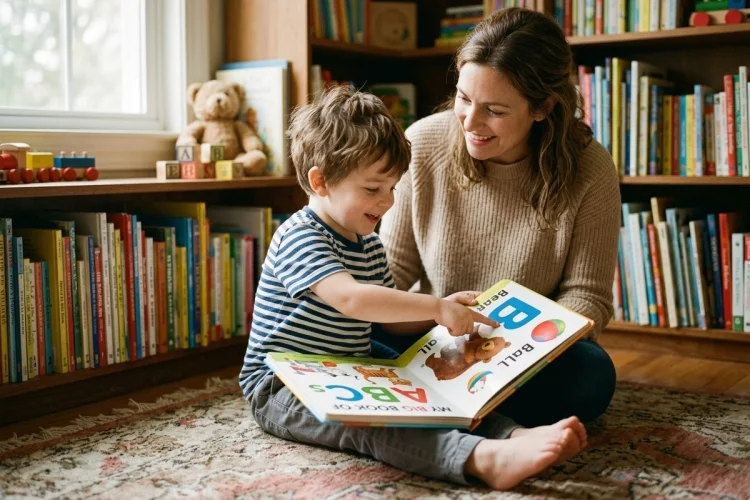
A child opens a picture book, points to a large B, and says, “That’s the letter in my name!” It may seem like a small moment, but it is actually an important step on the journey toward reading.
Children are not born knowing that marks on a page carry meaning. They gradually learn that books contain stories, printed words match spoken language, and letters can represent sounds.
Once these ideas begin working together, children can start turning symbols such as c-a-t into the spoken word “cat.” Understanding letters, sounds, and words helps adults see how reading begins.
It also explains why early literacy involves more than memorising the alphabet or recognising a few familiar words. Children need opportunities to listen, talk, rhyme, play with sounds, explore print, and enjoy books with supportive adults.
The process takes time, and every child develops at a slightly different pace. With playful practice and clear instruction, those mysterious marks on the page slowly become meaningful words, sentences, and stories.
Reading Begins Before a Child Reads a Book
Early reading development starts long before children can read independently. Babies listen to voices, toddlers learn new words, and preschoolers begin noticing signs, labels, logos, and letters in their surroundings.
These experiences build early literacy skills, including speaking, listening, vocabulary, print awareness, and story comprehension.
The National Association for the Education of Young Children explains that preschoolers often learn to recognise letters, hear rhymes, notice sounds in words, write their names, and understand stories before conventional reading begins.
For example, a child pretending to read a favourite book may repeat parts of the story from memory. The child is not decoding every printed word yet, but they are learning how books work, where a story begins, and how pictures connect with spoken language.
Talking also matters. Everyday conversations expose children to vocabulary and sentence patterns that later help them understand what they read.
Letters Are Symbols with Special Jobs
The alphabet is often the most visible part of learning to read. Children sing the alphabet song, play with magnetic letters, and search for the first letter of their names.
Knowing letter names is useful, but children must also understand that letters represent sounds. This idea is called the alphabetic principle: written letters and letter combinations have systematic relationships with the sounds in spoken language.
Consider the letter m. Its name is pronounced “em,” but its usual sound is the sound heard at the beginning of “moon.” Children need to learn the difference between a letter’s name and the sound it commonly represents.
Uppercase and lowercase forms can add another challenge. A child may recognise A but not immediately realise that a is the same letter. Matching games, alphabet books, and name-writing activities can help build this knowledge naturally.
It is usually more meaningful to connect letters with familiar words than to study them in isolation. The letter S becomes easier to remember when it is linked to “Sam,” “sun,” or “snake.”
Spoken Words Are Made of Smaller Sounds
Before children can use letters to read words, they need to notice the sound structure of spoken language. This broad skill is known as phonological awareness.
It begins with larger sound units. Children may identify rhyming words, clap the syllables in “ba-na-na,” or notice that “mother” and “moon” begin with the same sound.
A more specific skill, phonemic awareness, involves hearing and working with individual sounds called phonemes. The word “fish,” for example, contains three phonemes: /f/, /i/, and /sh/.
Phonemic awareness activities can be completed without showing printed letters. An adult might ask, “What word do these sounds make: /s/ /u/ /n/?” The child listens, blends the sounds, and answers “sun.”
Children can also practise separating words. Ask them to stretch “map” into /m/ /a/ /p/, using a finger or small block for each sound.
Research reviewed by the National Reading Panel found that explicit phonemic-awareness instruction can improve children’s word-reading skills.
Phonics Connects the Sounds to Print
Phonemic awareness is about hearing sounds, while phonics connects those sounds with written letters. The two skills support each other, but they are not exactly the same.
During phonics instruction, children may learn that s often represents /s/, while sh commonly represents a different sound. They then use these letter-sound relationships to read and spell unfamiliar words.
Effective phonics teaching is usually explicit and systematic. Rather than expecting children to discover every pattern alone, adults introduce useful relationships in a planned order and provide plenty of guided practice.
English can be tricky because one letter may represent different sounds. The letter a does not sound exactly the same in “cat,” “cake,” and “water.” Some sounds are also written with groups of letters, as in ch, ee, and igh.
Children do not need to learn every exception at once. They can begin with simple, regular patterns and gradually explore more complex spelling combinations.
Blending Turns Separate Sounds into Words
Once a child knows several letter-sound relationships, the next step is often blending. Blending means joining individual sounds together to form a complete word.
A beginning reader may look at d-o-g, say /d/ /o/ /g/, and then blend the sounds into “dog.” At first, this process may be slow and require encouragement.
Adults can make blending easier by keeping sounds connected. Instead of placing long pauses between /m/, /a/, and /p/, gently stretch them together: “mmm-aa-p, map.”
It is best to start with short words containing familiar sound patterns. Words such as “sit,” “map,” “run,” and “fish” can provide manageable practice, depending on which letter-sound relationships the child has learned.
Blending is not guessing from a picture or memorising the shape of the entire word. It is part of decoding, the process of using knowledge about letters and sounds to read printed words.
Word Recognition Becomes Faster with Practice
Beginning readers may need to sound out the same word several times. With repeated, successful reading, familiar spelling patterns become easier to recognise.
This growing automaticity matters because children have limited attention. When they spend all their effort decoding every letter, they may struggle to remember what the sentence means.
As word reading becomes smoother, more mental energy is available for understanding characters, events, facts, and ideas. This is one reason fluency, vocabulary, and comprehension remain important alongside phonics and phonemic awareness.
Rereading simple books can support this development. A familiar story allows children to practise words and sentences without facing completely new material on every page.
However, memorising a book is not the same as reading it. Adults can occasionally point to a word, ask the child to identify a sound, or use the same word in a new sentence to check understanding.
Meaning Is the Real Goal of Reading
Sounding out words is essential, but reading is not complete unless the child understands the message.
Imagine a child accurately reading, “The frog leaped into the pond,” without knowing what “leaped” or “pond” means. The sounds may be correct, but the sentence will not create a clear picture in the child’s mind.
Vocabulary and background knowledge help children understand text. Conversations, real-world experiences, nonfiction books, stories, songs, and play all add useful information to a child’s growing knowledge base.
Adults can support comprehension by asking natural questions during shared reading. “Why is the bear hiding?” encourages reasoning, while “What do you think will happen next?” invites prediction.
The conversation should remain enjoyable. Stopping after every sentence for a quiz can interrupt the story and make reading feel like a test.
Simple Ways to Support Beginning Readers
Early reading practice does not need to involve long worksheets. Short, playful activities can fit into ordinary family or classroom routines.
You can search for a particular letter on food packages, street signs, or book covers. During a walk, choose a sound and find objects whose names begin with it. At home, clap names into syllables or invent silly rhyming words.
Reading aloud remains valuable even after children begin decoding simple books. Shared stories expose them to vocabulary and ideas that may be too advanced for independent reading.
Let children attempt manageable words, but offer help before frustration takes over. Saying, “Look at the first sound,” is often more useful than simply telling them to guess from the picture.
Most importantly, avoid comparing children too closely. Persistent difficulty remembering letters, hearing sounds, blending, or learning common rhymes may justify a conversation with the child’s teacher or a qualified literacy specialist.
Early support can help identify and address reading challenges.
Letters, sounds, and words are the building blocks that show us how reading begins. Children first develop language and print awareness, then notice sounds in spoken words, connect those sounds to letters, and blend them into meaningful language.
The process is gradual. A child who struggles with a word today may recognise it confidently after several supportive practice sessions. What matters most is combining clear instruction with conversation, games, shared books, and encouragement.
Choose one simple activity today. Play a rhyming game, search for letters in the kitchen, stretch the sounds in a short word, or read a favourite story together. Every enjoyable connection between speech and print helps a young reader move closer to discovering an entire world of books.