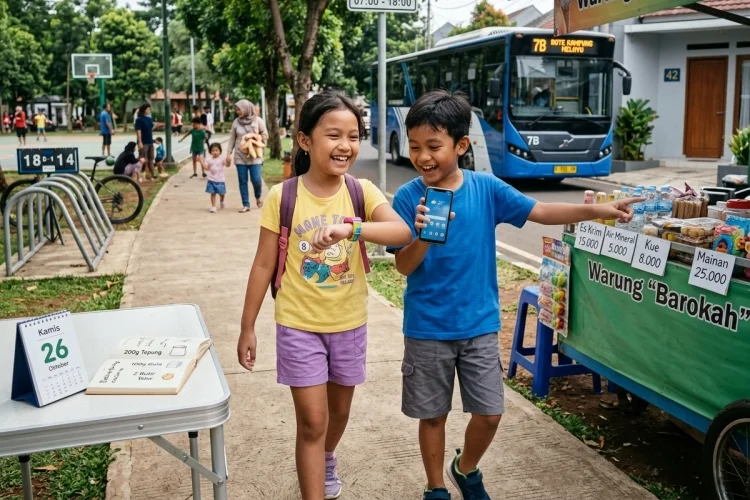
Numbers are everywhere, even when we are not sitting in a maths classroom. They appear on clocks, calendars, price tags, recipes, buses, sports scores, house doors, phones, and weather reports.
Imagine trying to plan your day without knowing what time school starts. How would you buy a snack without understanding its price? Could you bake a cake if the recipe did not tell you how much flour to use?
These examples help answer an important question: Why do we need numbers in everyday life? Numbers allow us to count objects, compare choices, measure things, organise information, and make sensible decisions.
They turn vague ideas such as “soon,” “a little,” or “far away” into information we can understand and use. Numeracy is not only about completing difficult calculations.
The OECD describes it as the ability to access, use, and think critically about mathematical information in different real-life situations. Let us explore how numbers quietly help us from morning until bedtime.
Numbers Help Us Count and Organise Things
Counting is one of the first ways children use numbers. You might count how many pencils are in your bag, how many players are on a team, or how many biscuits are left on a plate.
Counting helps us know whether we have enough of something. If eight children are coming to a party but there are only six chairs, numbers show that two more chairs are needed.
Numbers also help us put things in order. We use them for page numbers, classroom lists, race positions, floor numbers, and addresses. Without them, finding page 52 in a book or apartment 17 in a large building would be much harder.
Young children can develop mathematical understanding through normal routines such as tidying toys, sharing snacks, and comparing groups of objects. These everyday moments create natural opportunities to practise counting, addition, subtraction, and comparison.
Numbers Tell Us When Things Happen
Think about how often you look at a clock or calendar. Numbers tell you when to wake up, begin school, meet a friend, watch a programme, or go to bed.
Time helps people coordinate their activities. If a football match begins at 4:00 p.m., everyone knows when to arrive. If someone only says, “The match starts later,” each person may understand “later” differently.
Calendars use numbers to organise days, weeks, months, and years. They help us remember birthdays, holidays, appointments, school deadlines, and special events.
Numbers also show duration. A journey may take 20 minutes, a film may last two hours, and a school holiday may continue for two weeks. Understanding duration helps children plan what they can realistically do before the next activity begins.
A simple way to practise is to estimate how long a task will take. Guess how many minutes you need to pack your school bag, then use a timer to check.
Numbers Help Us Use Money Wisely
Money is one of the clearest examples of maths in everyday life. Prices, coins, banknotes, discounts, savings, and budgets all depend on numbers.
Suppose you have $10 and want to buy a book costing $7. Numbers tell you that you can afford it and should receive $3 in change. If the book costs $12, you know you need to save $2 more.
Understanding prices also helps us compare products. A large box may cost more than a small one, but it could offer better value if it contains much more. This is where multiplication, division, and comparison become useful outside the classroom.
Adults use the same skills to read bills, manage bank accounts, pay for transport, and plan household spending. OECD surveys examine everyday numeracy through tasks such as calculations, percentages, financial statements, maps, and diagrams.
Children can practise by running a pretend shop. Add prices to toys, use paper money, and work out totals and change.
Measurement Helps Us Cook, Build, and Create
Numbers tell us not only how many objects we have but also how big, heavy, hot, or long something is.
In cooking, recipes may ask for 200 grams of flour, two cups of milk, or 15 minutes in the oven. Using too much or too little of an ingredient can change the result.
Measurement is also important when building or making things. Before buying a new desk, someone might measure the available space. A child creating a cardboard castle may measure each wall so the pieces fit together.
Temperature numbers help us understand whether something is hot or cold. Weather forecasts use degrees to help us choose suitable clothes, while thermometers can provide useful health information.
Children naturally explore measurement while filling cups, stacking blocks, comparing heights, and moving objects. These practical experiences can build understanding of size, space, quantity, and problem-solving.
Try measuring the same table with a ruler, your hands, and building blocks. The results will show why standard units are useful.
Numbers Guide Us from Place to Place
Numbers make travelling and navigation easier. They appear on bus routes, train platforms, road signs, maps, airport gates, and house addresses.
Imagine looking for a friend’s home on a street where every building looks similar. A house number tells you exactly which door to find.
Public transport also depends on numerical information. You may need bus number 12, leaving at 8:15 from platform 4. Missing just one number could send you in the wrong direction.
Maps use scales to represent real distances in a smaller form. A map may show that one centimetre represents one kilometre. Phone navigation apps also calculate distances, estimated arrival times, and different routes.
The OECD’s numeracy framework includes locating, measuring, counting, designing, and interpreting information as mathematical actions used across cultures and everyday situations.
Numbers Make Games and Sports More Exciting
Many games would not work without numbers. Board games use numbered spaces, card games use values, and video games track points, levels, health, time, or collected objects.
Sports also depend on scores and measurements. Numbers tell us how many goals were scored, how fast someone ran, or how much time remains in a match.
Players use maths when planning strategies. A basketball team may need three points to take the lead. A runner may compare lap times to see whether they are becoming faster.
Statistics make it possible to compare performances across several games rather than judging someone from one moment.
However, numbers do not tell the whole story. A player may help the team through good communication or defence even without scoring many points.
Number-path and board games can help young children practise counting, comparing quantities, and understanding the order of numbers while they play.
Numbers Help Us Understand Information
News reports, websites, advertisements, and school projects often contain numerical information. You may see charts about rainfall, percentages in a survey, or graphs showing how something changes over time.
Numbers can make large amounts of information easier to understand. Instead of saying, “Many students chose football,” a survey might say that 18 out of 30 students chose it.
However, we should not believe every number immediately. We need to ask where the data came from, how it was collected, and whether important information has been left out.
For example, an advertisement might claim that a product is “50% better.” A careful thinker will ask, “Better at what?” and “Compared with which product?”
Numeracy therefore involves reasoning, not simply calculating. It helps people interpret mathematical information and decide whether a claim makes sense.
Strong Number Skills Support Future Independence
Children may sometimes wonder why they need maths after leaving school. The answer is that everyday responsibilities continue to involve numbers.
Adults use numeracy to compare salaries, understand work schedules, plan journeys, manage household costs, follow medicine instructions, and make financial decisions.
Mathematical reasoning is also used in careers ranging from nursing and construction to design, programming, retail, and cooking. Recent OECD findings show that foundational numeracy remains a serious challenge for many adults.
A 2026 report estimated that nearly one in three adults across participating OECD economies lacked the foundational literacy or numeracy needed to participate fully in modern society and the economy.
This does not mean everyone must become an advanced mathematician. It means that feeling comfortable with everyday numbers can support confidence, independence, and better decision-making.
How to Practise Numbers Every Day
You do not need a worksheet whenever you want to improve your number skills. Daily life is already full of mathematical practice.
Count steps while walking, compare supermarket prices, estimate the total cost of two items, or measure ingredients while cooking. You can also read a bus timetable, track the temperature for a week, or calculate how many days remain until a birthday.
Adults can bring maths into normal conversations by discussing shapes, patterns, sizes, quantities, and time. Shopping trips, meals, neighbourhood walks, and games all provide opportunities for this kind of mathematical talk.
The goal is not to turn every activity into a test. It is to notice that numbers are useful tools for answering real questions.
Why do we need numbers in everyday life? We use them to count belongings, follow schedules, spend money, measure ingredients, find places, play games, and understand information.
Numbers help replace guesses with clearer answers. They show us how much, how many, how long, how far, and when. Strong numeracy skills also prepare children for greater independence at school, at work, and in adult life.
The best way to become comfortable with numbers is to use them in meaningful situations. Look around today and find five places where numbers appear.
Check a clock, measure an object, compare two prices, or count something nearby. You may discover that everyday life is one big, interesting maths lesson.