Five, six, seven, eight-then back we go: eight, seven, six, five! Counting may seem like a simple activity, but changing direction can turn it into an exciting challenge for young learners.
Counting forward and backward helps children understand that numbers follow an order. Moving forward shows that each next number is one more, while moving backward shows that each previous number is one less.
These ideas later support addition, subtraction, number comparison, and mental maths. However, practising a number sequence does not have to mean sitting at a table and repeating numbers again and again.
Children can count while jumping, marching, building towers, playing board games, reading stories, or preparing snacks. When numbers are connected to movement and meaningful goals, maths becomes easier to understand and more enjoyable.
This guide explores playful counting activities for home or the classroom. Whether a child is learning to count from 1 to 10 or starting from different numbers, there are plenty of ways to make every step count.
Why Counting in Both Directions Matters
Counting forward is usually one of the first mathematical skills children practise. They may begin by repeating number words like a song before fully understanding what each number represents.
As their knowledge grows, children learn to connect one number word with one object. For example, they might touch four toy cars one at a time while saying, “One, two, three, four.” This is called one-to-one correspondence.
Counting backward is more challenging because children must reverse the familiar sequence. Instead of following the automatic pattern from one, they need to remember which number comes immediately before another.
These abilities contribute to number sense-the understanding of how numbers relate to quantities and to one another.
Early counting competencies, including counting forward or backward from a given number, have also been studied as possible predictors of later mathematics achievement.
The aim is not simply to memorise a long sequence. Children should gradually understand what happens to quantity when numbers increase or decrease.
Begin with Real Objects Children Can Touch
Young learners often understand numbers more easily when they can see and move real objects. Buttons, blocks, toy animals, bottle caps, socks, or pieces of fruit can all become counting tools.
Place five blocks in a row. Ask the child to touch each block while counting forward from one to five. Then remove the blocks one at a time and count backward from five to zero.
The objects make the changing quantity visible. When one block disappears, the child can see why the number becomes smaller.
Start with a range the child can manage confidently. Counting between one and five is enough for a beginner. Once that feels comfortable, extend the activity to ten, twenty, or beyond.
Avoid moving too quickly just because a child can recite a long sequence. Saying the number words is useful, but meaningful counting also requires matching each number to an item and understanding that the final number tells how many objects are in the group.
Turn the Floor into a Giant Number Path
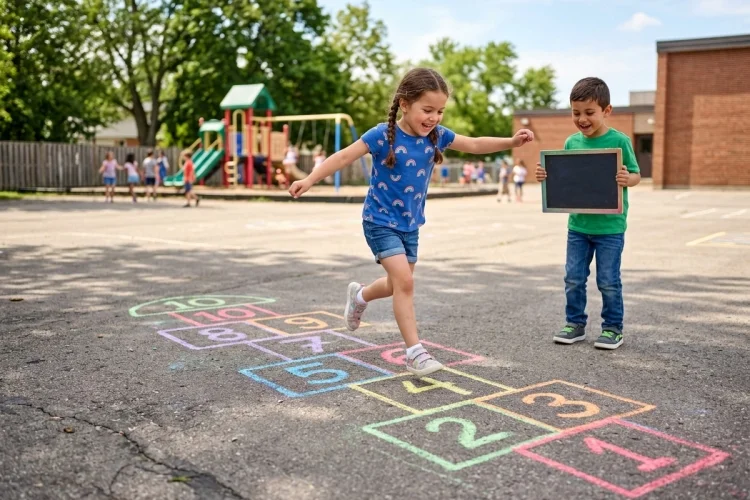
A number path is a row of spaces labelled in order, such as 1 to 10. It can be drawn with chalk outside or created indoors using sheets of paper and tape.
Ask the child to stand on number one and jump forward while saying each number. When they reach ten, they can turn around and jump backward to one.
Number-path games help children practise numeral recognition, stable counting order, one-to-one movement, and the idea that numbers come before or after other numbers.
A large path also allows children to become the playing piece, connecting physical movement with numerical change.
Make the game more interesting by giving directions:
“Start at three and move forward four spaces.”
“Stand on eight and jump backward twice.”
“Which number is one step before six?”
As children become more confident, leave several spaces blank. They must work out which numerals are missing before starting the game.
Play Hopscotch with a Maths Twist
Traditional hopscotch already contains numbers, movement, balance, and a clear path. A few small changes can turn it into a fun forward-and-backward counting game.
First, let children hop from one to ten while saying the numerals aloud. When they reach the end, challenge them to return while counting from ten down to one.
DREME recommends using hopscotch to practise number sequences, numeral recognition, counting from a number other than one, and thinking about the relationships between numbers. It can also be adapted for backward or skip counting.
1. Try a Mystery Number
Cover one space with a piece of paper or draw an empty square. The child must say which number belongs there before hopping across it.
2. Change the Starting Point
Rather than always beginning at one, say, “Start on four and count forward to nine.” On the next turn, ask the child to start at eight and count backward to three.
This encourages flexible thinking instead of relying only on a memorised chant.
Use Songs, Rhymes, and Countdown Stories
Music makes number patterns easier to remember. Repetition, rhythm, and predictable language help children join in even when they do not yet know the complete sequence.
Forward-counting songs can involve marching from one to ten, adding one movement with every number. Backward songs work especially well when objects disappear from the story, such as ducks swimming away or rockets preparing to launch.
You can also invent a simple countdown story. Place ten toy dinosaurs on a table and say, “Ten dinosaurs were having lunch. One went home. How many are left?”
Remove one dinosaur and continue until none remain. The changing group gives the countdown a clear meaning.
A 2024 study discussed by DREME found that children gained more counting knowledge when counting prompts were placed within a rich, goal-based story than when similar practice was presented without a meaningful context.
The story does not need to be complicated. Children are often more engaged when the characters involve their favourite animals, foods, sports, or toys.
Make Counting Part of Everyday Routines
Maths practice does not always need a specially planned lesson. Normal routines contain many opportunities to count up and down.
While climbing stairs, count forward on the way up and backward on the way down. During tidy-up time, count how many toys still need to go into the box.
At snack time, place one cracker on a plate and count forward as more are added. Before eating, count backward as each cracker disappears.
The Education Endowment Foundation recommends using routines such as snack time, registration, and tidying to create conversations about counting, comparison, addition, subtraction, and sharing.
Other quick ideas include counting the seconds before leaving the house, tracking days until a birthday, or counting backward while waiting for a turn. These short activities show children that numbers are useful outside a workbook.
Keep the conversation natural. A playful question such as “We have six cups but need eight-how many more?” is more meaningful than suddenly testing a child without context.
Try Simple Card and Board Games
Numbered cards are excellent tools because they can be arranged, hidden, shuffled, and compared.
Lay cards from one to ten in order. Ask the child to close their eyes while you turn one card over. They must identify the hidden number by counting forward or backward from a visible card.
For example, when seven is visible and the next card is hidden, the child can say, “Seven, eight,” rather than beginning again at one. Starting from an existing number is known as counting on.
DREME’s “Magician’s Tricks” activity uses hidden numbered cards to help children practise counting, number relationships, and finding the numbers that come before or after a chosen card.
The game can be adjusted as the child progresses from small quantities to backward counting and counting from different starting points.
Linear board games are another useful option. Games with equal-sized, consecutively numbered spaces can support numerical understanding and encourage children to count on from their current position.
The game does not need expensive materials. A homemade board, a button as a token, and a simple die are enough.
Connect Forward Counting to Addition
Children often begin solving addition problems by counting every object from one. If they have three blocks and receive two more, they may recount the entire group: “One, two, three, four, five.”
Counting forward from a known number offers a more efficient strategy. A child can remember the first quantity-three-and count on two steps: “Four, five.”
Use a number path to make this movement visible. Start a token on three, move forward two spaces, and land on five. Say the complete idea aloud: “Three and two more makes five.”
Number-path games provide repeated opportunities to practise counting on, which can prepare children to use this strategy when learning addition.
Begin with small numbers so the child can focus on the strategy. Fingers can also help track how many steps have been counted.
The goal is not to rush into written equations. It is to help children understand addition as moving forward or making a quantity larger.
Connect Backward Counting to Subtraction
Backward counting creates a natural bridge to subtraction. It shows that taking something away makes a quantity smaller.
Suppose there are seven toy animals and two walk away. Begin at seven and count back two steps: “Six, five.” Five animals remain.
Children can act out the problem, use counters, or move backward on a number path. This gives meaning to the numbers instead of making subtraction look like a mysterious set of symbols.
Countdowns are another simple example. When a rocket launches after “Five, four, three, two, one,” each number moves one step closer to zero.
Do not worry when a child pauses or returns to counting objects from the beginning. Counting backward and subtracting mentally are harder skills that develop through repeated experiences.
Learning happens over time, so children benefit from playful practice in different contexts.
Keep the Challenge Positive and Playful
Children learn at different speeds. One child may confidently count backward from twenty, while another is still organising the numbers between one and five.
Offer a challenge that is slightly above what the child can already do. When counting backward from ten is difficult, begin at five. When counting from five is easy, start at seven or ask for every other number.
Praise the process rather than only the correct answer. Comments such as “You noticed that six comes before seven” are more helpful than simply saying “Good job.”
It is also useful to ask children how they found an answer. They may have imagined a number path, used their fingers, or remembered part of a song. Discussing strategies can strengthen mathematical language and reasoning.
Most importantly, stop before the activity becomes frustrating. Five enjoyable minutes repeated regularly can be more valuable than one long session filled with pressure.
Counting forward and backward gives children more than the ability to recite numbers. It helps them understand order, recognise what comes before and after, compare quantities, and build early addition and subtraction strategies.
The most effective practice often feels like play. Children can jump along a number path, sing a countdown song, hide numbered cards, move pieces around a board, or count objects during everyday routines.
Begin with a small number range and increase the challenge gradually. Let children touch, move, explain, and experiment rather than expecting instant answers.
Choose one activity today-perhaps a ten-step number path or a toy countdown-and discover how much fun numbers can become when children move in both directions.