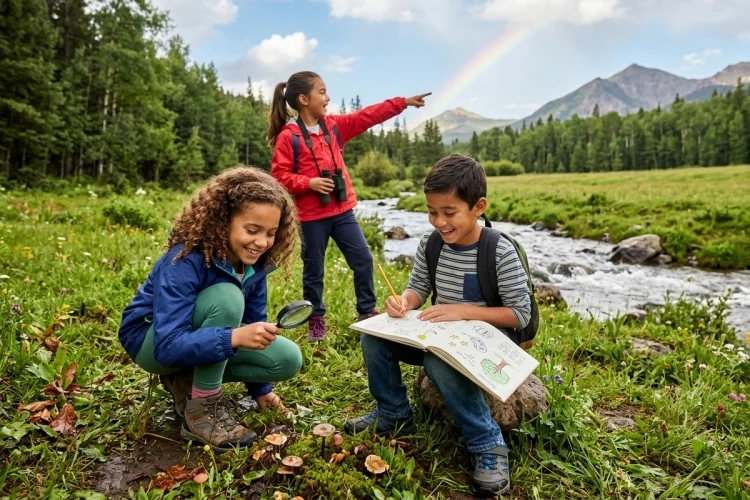
Why does rain fall from clouds? How can a tiny seed grow into a tall tree? What makes a rainbow appear, and could there be life on another planet?
Questions like these are where science begins. Science is not simply a collection of facts that students memorise for a test. It is a way of exploring the natural world, testing ideas, collecting evidence, and building explanations.
So, what is science and why is it exciting? Science is exciting because it turns curiosity into discovery. It allows us to investigate everything from the smallest cells to the largest galaxies.
It can explain ordinary events, help solve serious problems, and sometimes reveal things nobody expected to find. You also do not need a white coat or a giant laboratory to think like a scientist.
Children use scientific thinking whenever they observe something carefully, ask how it works, make a prediction, or compare results. Let us explore what science really means and how young investigators can experience its excitement every day.
Science Is a Way of Finding Things Out
Science is both the knowledge we have gathered about the natural world and the process used to develop that knowledge. It includes what we know about animals, matter, energy, weather, space, the human body, and many other subjects.
However, science is not based on someone simply saying that an idea is true. Scientific explanations must be connected to observations and evidence that other people can examine.
The National Academies describes science learning as more than memorising separate facts. Students should practise asking questions, creating models, planning investigations, analysing information, constructing explanations, and communicating what they find.
This means science is something people actively do. Reading about volcanoes is valuable, but investigating how pressure can cause a model eruption helps children explore the ideas more directly.
Great Science Often Starts with a Question
Scientists are professional question-askers. They notice something interesting, confusing, or unexpected and try to understand it.
A child might wonder why an ice cube melts faster outside than inside. Another might notice that a plant near a window grows differently from one in a darker corner.
These observations can become scientific questions:
“Does sunlight affect how quickly ice melts?”
“Do plants grow better with more light?”
“Which material keeps water warm for the longest time?”
Questions that can be explored through observation, measurement, or testing are especially useful.
The National Science Teaching Association explains that productive inquiry gives children direct experiences with materials and encourages them to investigate questions through their own actions and observations.
Children do not always need an immediate answer. Sometimes, the most helpful response from an adult is, “How could we investigate that?”
Evidence Is Science’s Superpower
Anyone can have an idea, but science asks an important follow-up question: What evidence supports it?
Evidence can come from measurements, observations, photographs, samples, experiments, or patterns in collected data. For example, saying that one toy car is faster than another is an opinion until both cars are tested under similar conditions.
A young scientist could release each car from the same ramp, mark where it stops, and repeat the test several times. The results would provide more reliable information than one quick race.
Scientists also share methods and findings so that other people can examine their work. Scientific knowledge may be revised when stronger evidence or better tools become available.
UC Berkeley describes science as a dynamic, creative, and repeated process in which ideas are tested, reconsidered, and tested again.
Changing an explanation is not a weakness. It shows that science is designed to improve when we learn something new.
Experiments Feel Like Solving Mysteries
An experiment is a planned test used to investigate a question. It allows scientists to change something, observe what happens, and compare the results.
Suppose you want to know whether sugar dissolves faster in warm or cold water. You could prepare two equal glasses of water, change only the temperature, add the same amount of sugar, and record how long it takes to disappear.
Before testing, you can make a prediction. A prediction is not a random guess. It is what you think will happen based on what you already know.
The result may support your prediction, but it may also surprise you. Both outcomes are useful because an experiment is meant to provide information, not to prove that you were clever enough to guess correctly.
Science also does not always follow one perfect set of steps. Different questions may require field observations, computer models, comparisons, long-term measurements, or laboratory experiments.
Scientists often move backward and forward between ideas, evidence, discussion, and further testing.
Science Is Hidden in Everyday Life
Science is happening around you from the moment you wake up. Your alarm produces sound waves, toothpaste contains carefully designed materials, and breakfast changes through physical and chemical processes when it is cooked.
On the way to school, gravity keeps your feet on the ground, friction helps tyres grip the road, and weather conditions affect what you wear. Even kicking a ball involves forces, motion, energy, and air resistance.
1. Life Science
Life science explores living things. It includes plants, animals, cells, habitats, inheritance, and the human body.
Watching caterpillars grow, comparing different leaves, or observing how quickly seeds germinate are simple ways to explore biology.
2. Physical Science
Physical science examines matter, forces, energy, light, sound, electricity, and motion. Children investigate it when they build ramps, mix safe materials, create shadows, or explore magnets.
3. Earth and Space Science
Earth and space science investigates our planet, weather, oceans, rocks, the Moon, stars, and the wider universe. NASA provides child-friendly resources covering topics such as climate, water, planets, and space exploration.
These branches are connected. Studying a forest, for example, may involve animals, soil, rainfall, sunlight, and human activity.
Mistakes and Surprises Move Science Forward
Many children worry about giving the wrong answer. In science, an unexpected result can be the most interesting part of an investigation.
Perhaps your paper airplane flies in the opposite direction from what you predicted. Instead of hiding the result, ask what may have caused it. Was one wing folded differently? Did the wind change? Was the launch stronger?
Scientists regularly examine unexpected findings, improve their methods, and repeat investigations. Science is iterative, which means ideas and procedures may be refined many times as understanding grows.
Good scientists also record what actually happened rather than changing their notes to match the result they wanted. Honest observations make it possible to learn from mistakes.
The next time an experiment “fails,” try saying, “That was not what I expected. What can the result teach me?”
Kids Can Take Part in Real Scientific Research
Scientific discovery is not limited to professional laboratories. Members of the public can sometimes work with researchers through citizen science projects.
Citizen scientists may photograph clouds, record animal sightings, classify images, monitor water quality, or analyse information collected by telescopes.
NOAA describes citizen science as a partnership in which volunteers help investigate real-world questions and may contribute to collecting, analysing, or interpreting data.
NASA also offers public projects involving Earth science, planetary science, astronomy, and other fields. Some opportunities are marked as suitable for children or classrooms, including projects that involve observing Earth or searching astronomical images.
Children should participate with a parent, teacher, or responsible adult, especially when a project requires an account, location information, outdoor travel, or online communication.
Real research makes science feel exciting because every careful observation can become part of a much larger investigation.
Easy Ways to Make Science Exciting at Home
You can begin exploring science with ordinary household materials. Always ask an adult before starting, and never mix unknown substances or taste experiment materials.
1. Become a Shadow Tracker
Choose a safe outdoor spot and mark the end of a shadow in the morning, at midday, and later in the afternoon. Record how its length and direction change.
This activity can lead to questions about sunlight, Earth’s movement, time, and why shadows appear.
2. Test What Sinks and Floats
Collect several safe objects, such as a plastic cap, spoon, leaf, stone, and small ball. Predict what each object will do before placing it in a bowl of water.
Record the results and compare the objects. Do not assume that every heavy object sinks or every small object floats-look for evidence.
3. Create a Mini Weather Journal
Record the temperature, cloud cover, rainfall, and wind at approximately the same time each day. After one or two weeks, search for patterns.
NOAA offers short hands-on activities designed to get learners thinking about how natural systems work, showing that meaningful science can begin with accessible observations and materials.
The purpose of these activities is not to produce perfect results. It is to practise noticing, predicting, recording, comparing, and explaining.
Science Helps Us Think More Carefully
Science gives us useful knowledge, but it also teaches a way of thinking.
When someone makes a surprising claim, scientific thinking encourages us to ask for evidence. We can consider whether the source is reliable, whether the test was fair, and whether another explanation is possible.
These skills are useful when reading advertisements, watching online videos, choosing products, understanding health advice, or discussing environmental problems.
The National Academies identifies evaluating information, using mathematics, analysing data, explaining results, and arguing from evidence as essential scientific practices.
These abilities can help students become more thoughtful users of scientific and technological information in everyday life.
Science does not provide an instant answer to every question. What it offers is a careful way to investigate what we do not yet understand.
What is science and why is it exciting? Science is a way of exploring the natural world through questions, observations, evidence, experiments, and explanations.
It is exciting because every investigation can reveal a pattern, solve a mystery, or create an entirely new question. Young scientists do not need expensive equipment.
A notebook, a few safe materials, and a curious mind are enough to begin. Mistakes are welcome, surprising results are useful, and changing your mind after seeing better evidence is part of good scientific thinking.
Choose one mystery from your everyday life today. Ask a clear question, predict what might happen, and design a safe way to investigate it. Your first discovery may be closer than you think.