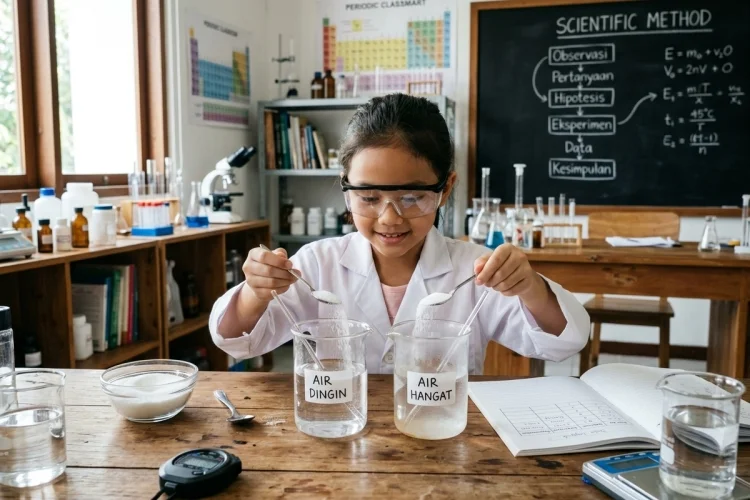
Have you ever noticed that sugar seems to disappear faster in warm water than in cold water? You could accept a quick answer, but a young scientist would probably want to test it.
That is where the scientific method becomes useful. It provides a practical way to move from curiosity to evidence by asking a clear question, making a prediction, planning a fair test, recording results, and deciding what those results mean.
NASA describes it as a way of moving from observations toward answers, although real investigations are often more flexible than a perfectly straight list of steps.
In this guide, you will learn how to use the scientific method for a simple experiment by testing whether water temperature affects how quickly sugar dissolves.
The activity introduces hypotheses, variables, repeated trials, data tables, and evidence-based conclusions using common materials. Ask an adult to supervise, especially when preparing warm water, and never taste materials used in an experiment.
Understand What the Scientific Method Does
A classroom-friendly scientific method often includes observing, asking a question, researching the topic, forming a hypothesis, conducting a test, analysing data, and communicating a conclusion.
However, scientists do not always follow these stages in exactly the same order. They may redesign an investigation, collect more evidence, or develop a new question after finding something unexpected.
The National Science Teaching Association explains that science uses many methods rather than one fixed recipe.
The important part is the thinking: ask something testable, gather reliable evidence, report honestly, and create an explanation that other people can examine.
Step 1: Ask a Testable Question
A useful experiment begins with something you genuinely want to know. For this activity, your observation might be, “Sugar appears to dissolve faster in some drinks than in others.”
Turn that observation into a focused question:
Does water temperature affect how quickly one teaspoon of sugar dissolves?
This question works because you can change the temperature and measure the dissolving time. A question such as “Which drink is nicest?” is harder to investigate scientifically because the answer mainly depends on personal preference.
Asking investigable questions, planning tests, analysing information, and constructing explanations are central scientific practices identified by the National Academies.
Step 2: Research and Write a Hypothesis
Do a little background research before beginning. You might read about dissolving, temperature, and the movement of particles in liquids.
Next, write a hypothesis—a statement that your experiment can test. For example:
If the water is warmer, then the sugar will dissolve faster because the water particles are moving more quickly.
A hypothesis does not have to be correct. Its job is to give your investigation a clear prediction. Results that disagree with your idea are still valuable because they may reveal something you did not expect.
Step 3: Identify Variables and Plan a Fair Test
A variable is something that can change. The independent variable is what you deliberately change; here, it is the water temperature. The dependent variable is what you measure, which is the time taken for the sugar to dissolve.
Controlled variables are the conditions kept the same. Use identical cups, equal quantities of water, the same sugar type and amount, and the same stirring method. This makes it easier to tell whether temperature caused the difference.
Plan three conditions: cool water, room-temperature water, and comfortably warm water prepared by an adult. Do not use boiling or very hot water.
Step 4: Conduct the Experiment Carefully
Gather three identical clear cups, water at three safe temperatures, granulated sugar, a teaspoon, a timer, a measuring cup, and a notebook. A thermometer is helpful but not essential.
Pour 150 millilitres of water into each cup and label them “cool,” “room temperature,” and “warm.” Record the temperature when a thermometer is available.
Add one level teaspoon of sugar to the cool water and start the timer immediately. Stir at a steady speed until no crystals are visible, stop the timer, and record the result. Follow exactly the same procedure for the other two cups.
Avoid changing two conditions together. Stirring the warm cup much faster would make it difficult to know whether temperature or stirring caused the result.
Step 5: Record Data and Repeat the Test
Write every measurement down immediately. Scientists record what actually happens, not what they hoped would happen.
Your results table could look like this:
| Water Condition | Trial 1 | Trial 2 | Trial 3 |
|---|---|---|---|
| Cool | 72 sec | 69 sec | 75 sec |
| Room temperature | 46 sec | 49 sec | 47 sec |
| Warm | 21 sec | 24 sec | 22 sec |
These numbers are only an example. Your results may be different.
Repeat each condition three times. One test can be affected by a slow timer start, uneven stirring, or a measurement mistake. Repeated trials help you see whether the same general pattern appears again.
Scientists often organise observations in tables or graphs before interpreting them. Data collection and analysis provide the evidence used to answer the original question.
Step 6: Analyse the Evidence and Draw a Conclusion
Compare the results. Which water condition produced the shortest time? Were the three trials similar, or was one measurement very different?
You can calculate an average by adding the three times for one condition and dividing by three. In the example, the average times are 72 seconds for cool water, about 47 seconds for room-temperature water, and about 22 seconds for warm water.
A clear conclusion might say:
The results supported my hypothesis. Sugar dissolved fastest in warm water and slowest in cool water, suggesting that warmer water reduced the dissolving time under the conditions tested.
Use careful language. Your experiment supports a conclusion for the materials and temperatures tested; it does not prove that every substance will behave in exactly the same way.
Step 7: Share, Improve, and Ask Another Question
Explain your investigation in a short report, poster, graph, or presentation. Include the question, hypothesis, variables, procedure, results, and conclusion.
Do not hide an unusual result. Mention it and suggest a possible reason. Honest reporting, explaining ideas from evidence, and communicating findings are important parts of scientific work.
Next, consider how you could improve the test. You might measure temperature more precisely, use a metronome to control stirring speed, or record the experiment to check the timing.
Your conclusion may also inspire another question: Does crushed sugar dissolve faster than a sugar cube? Does stirring speed matter? Change only one main variable during each new test so the comparison remains clear.
NASA offers many science-at-home activities showing how everyday materials and observations can become useful investigations.
Common Mistakes Young Scientists Should Avoid
One common mistake is choosing a question that is too broad. “How does water work?” is interesting, but “Does water temperature affect dissolving time?” is much easier to test.
Another problem is changing several variables at once. Using different cups, different quantities of sugar, and different stirring speeds would make the results difficult to explain.
Young investigators may also rush to a conclusion after a single trial. Repeating the experiment, checking measurements, and recording unexpected outcomes make the final explanation more reliable.
Most importantly, remember that an unsupported hypothesis does not mean the experiment failed. The goal is to discover what the evidence shows, not to force the results to match your original prediction.
Learning how to use the scientific method for a simple experiment turns everyday curiosity into an organised investigation. You ask a focused question, form a hypothesis, identify variables, conduct a fair test, record data, and create a conclusion based on evidence.
The sugar experiment is easy to perform, but the thinking behind it is powerful. Careful measurement, repeated trials, honest notes, and thoughtful analysis are habits used throughout science.
Choose one safe question from your home, garden, or classroom and write it in a science notebook. Plan a fair test with adult supervision, record what really happens, and share what you discover. One small experiment may answer your first question-and inspire several new ones.