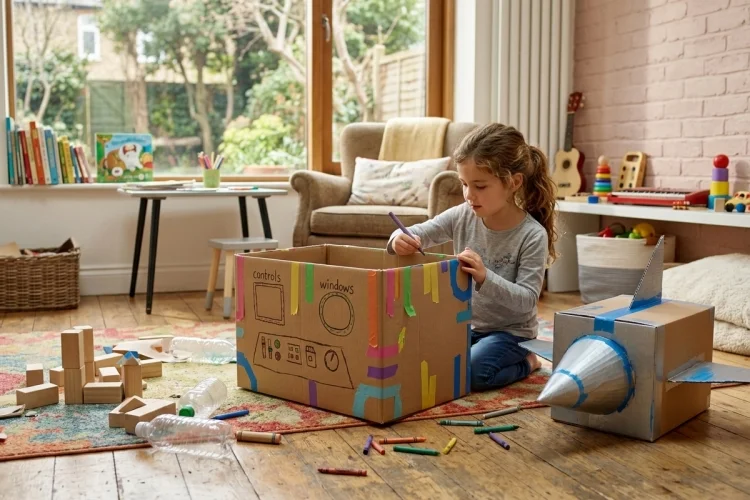
Give a child an empty cardboard box, and something surprising may happen. It could become a spaceship, a castle, a robot, or a secret home for stuffed animals. An adult may see packaging, but a creative child sees possibilities.
So, why is creativity important for children? Creativity helps young people generate ideas, explore different solutions, express emotions, and make sense of their experiences. It is not limited to drawing beautiful pictures or playing music.
Children also use creative thinking when they invent a game, build a tower, solve a disagreement, write a story, or find a new way to complete a task. Creativity does not always require expensive materials or formal lessons.
It can grow through free play, conversations, storytelling, movement, construction, music, and everyday problem-solving. UNICEF describes play as an important opportunity for children to explore the world in their own way while developing imagination and creativity.
By giving children time, freedom, and encouragement to create, adults can support skills that matter both now and in the future.
Creativity Is More Than Art
When people hear the word “creativity,” they often imagine painting, dancing, acting, or making music. These activities are creative, but they are only part of the picture.
Creativity means producing ideas that are original, useful, or meaningful in a particular situation. A child uses it when finding several ways to build a bridge from blocks or deciding how story characters can escape from a problem.
The OECD’s PISA 2022 assessment examined creative thinking through written expression, visual expression, social problem-solving, and scientific problem-solving.
This broad approach shows that creativity can appear in academic work, relationships, practical challenges, and artistic activities.
A creative child does not necessarily need to be the best artist in class. They may simply be willing to ask, “What else could I try?”
Creative Thinking Improves Problem-Solving
Many everyday problems have more than one possible answer. Creativity helps children move beyond the first idea and consider different approaches.
Imagine that a toy car cannot cross a gap between two chairs. A child might create a bridge from books, cardboard, building blocks, or a wooden board. Each attempt requires planning, testing, and adjusting.
This process teaches children that a problem is not always a dead end. It may be an invitation to experiment.
Open-ended activities are especially useful because they do not have one required result. Building materials, puzzles, pretend play, and recycled objects encourage children to make choices and develop their own solutions.
UNICEF notes that activities such as block building, imaginative play, and solving puzzles can support critical thinking and a love of learning.
Adults can encourage this skill by asking, “What have you tried?” or “Can you think of another way?”
Creativity Makes Learning More Engaging
Children are often more interested in learning when they can participate actively rather than only listen and repeat information.
A lesson about animals can become a pretend wildlife expedition. A maths activity can involve designing a shop, making prices, and counting change. A science topic can turn into an experiment with shadows, water, plants, or magnets.
Creative learning allows children to connect new information with experiences that feel meaningful. It also gives them different ways to demonstrate understanding.
One child may explain a topic through writing, while another builds a model or creates a picture. A third may act out the idea through dramatic play.
NAEYC highlights creative activities involving art, storytelling, construction, movement, music, and make-believe as useful forms of expression and learning during early childhood.
The goal is not to turn every lesson into entertainment. It is to give children an active role in exploring ideas.
Creative Play Supports Flexible Thinking
Flexible thinking is the ability to change direction when an idea does not work. It helps children adjust to new rules, unexpected situations, and different points of view.
During pretend play, children constantly practise this skill. A cardboard tube may begin as a telescope and later become a microphone. One child may play the doctor, then switch roles and become the patient.
Creative games also require children to remember ideas, control impulses, and adapt their behaviour. Harvard’s Center on the Developing Child explains that playful activities can help children practise executive function skills such as attention, working memory, and self-control.
These abilities are useful far beyond playtime. Children need flexible thinking when school instructions change, a group project takes an unexpected turn, or their original plan fails.
Instead of immediately fixing every difficulty, adults can give children time to reconsider and try again.
Creativity Builds Confidence and Independence
Creating something involves making choices. A child decides which colours to use, how a story will end, or what materials are needed for a model.
These decisions help children develop a sense of ownership. They begin to understand that their ideas have value and that they can turn an idea into something real.
Confidence grows when adults pay attention to the process rather than judging only the final product. Saying, “Tell me how you made this,” invites the child to explain their thinking.
Saying, “Why did you make the sky green?” may sound like criticism if the child believes there is a correct artistic answer.
Process-based art is helpful because it allows children to experiment without copying one perfect example. NAEYC explains that open-ended creative experiences can support enjoyment, thinking skills, language development, and healthy development.
Children become more independent when they are trusted to choose, test, revise, and complete age-appropriate projects.
Creative Activities Help Children Express Emotions
Young children do not always have the vocabulary to explain complicated feelings. Creative activities can provide another way to communicate.
A drawing may show something a child found exciting or frightening. Pretend play may allow them to repeat a confusing experience, such as visiting a doctor or starting school, until it feels easier to understand.
Music, dance, storytelling, clay, and painting can all give children a safe space to explore emotions. The result does not need to look polished or realistic.
Adults can support emotional expression by showing interest without making quick assumptions. A useful response might be, “There is a lot happening in your picture. Would you like to tell me about it?”
Creative play can also give children a sense of competence when they solve a puzzle, finish a project, or develop an imaginative solution. UNICEF connects playful problem-solving with feelings of accomplishment and capability.
Creativity does not replace professional support when a child is struggling, but it can make everyday communication more comfortable.
Imagination Supports Language and Communication
Creative play gives children reasons to use language. They describe imaginary worlds, explain rules, name characters, negotiate roles, and tell stories.
A simple game of “restaurant” may involve creating a menu, taking orders, discussing prices, and explaining how meals are prepared. Children practise vocabulary and conversation while having fun.
Storytelling develops similar skills. A child must decide who the characters are, where the story happens, what goes wrong, and how the problem is solved.
UNICEF notes that imaginative free play can encourage creativity and language as children learn to express their ideas verbally.
Adults can extend the conversation with open-ended questions. Instead of asking, “Is that a house?” try, “Who lives there?” or “What happens inside?”
These questions invite longer answers without controlling the child’s story.
Creativity Helps Children Work with Others
Many creative activities are social. Children build together, create games, perform stories, or design shared imaginary worlds.
Group creativity requires communication and compromise. One child may want the blocks to become a castle, while another imagines a zoo. They must decide whether to choose one idea, combine both, or create separate areas.
Small disagreements can become valuable learning moments. Children practise listening, explaining their preferences, and adjusting a plan.
Pretend play also encourages perspective-taking. When children act as teachers, shopkeepers, parents, astronauts, or animals, they experiment with roles and consider how someone else might behave.
Adults should avoid controlling every part of group play. They can step in when safety or serious conflict becomes an issue, but minor negotiations give children opportunities to develop social problem-solving skills.
Creative collaboration teaches that good ideas can become even stronger when people contribute different perspectives.
Creativity Prepares Children for a Changing Future
Nobody can predict exactly which challenges today’s children will face as adults. Technology, workplaces, and communities will continue to change.
Memorised knowledge remains important, but young people also need to generate ideas, evaluate options, improve existing solutions, and adapt to unfamiliar situations. These abilities are central to creative thinking.
The OECD’s creative-thinking framework includes generating diverse ideas, producing creative ideas, and evaluating or improving them. These are not only artistic abilities; they are useful for scientific questions, social challenges, communication, and innovation.
Encouraging creativity does not mean preparing every child to become an inventor or designer. It means helping them feel comfortable with uncertainty and capable of exploring more than one answer.
A child who learns to say, “That did not work, so I will try something different,” is developing a valuable lifelong habit.
How Adults Can Encourage Creativity
Children need time and space to develop their own ideas. Filling every free moment with structured activities may leave little room for imagination.
Provide simple open-ended materials such as paper, crayons, boxes, fabric, blocks, clay, tape, and safe recycled objects. These can often inspire more possibilities than toys designed to perform only one action.
Avoid correcting creative choices that are not dangerous. A purple elephant, upside-down house, or impossible machine may be exactly what the child intended.
Adults can also model creativity. Invent a silly story together, find several uses for an ordinary spoon, or build something without instructions. Showing curiosity makes experimentation feel normal.
Free play is especially valuable because children choose the direction, rules, and purpose of the activity. UNICEF recommends allowing children opportunities to explore in their own way rather than directing every detail.
Most importantly, praise effort, imagination, and persistence-not just attractive results.
Why is creativity important for children? It strengthens problem-solving, flexible thinking, communication, emotional expression, confidence, and cooperation.
It can also make learning more active and help children adapt when their original ideas do not work. Creativity does not require costly classes or special talent.
It grows when children have time to play, experiment, make choices, and explore without worrying that every result must be perfect. Start with one simple opportunity today.
Offer a cardboard box, tell a story without a fixed ending, create something from recycled materials, or ask how many solutions a child can find for a small problem. Give them space to lead the activity-and enjoy discovering where their imagination takes them.